There is no federal or state law anywhere in the United States that prohibits killing a praying mantis. Not one state legislature has ever passed a statute protecting this insect, and no federal wildlife law lists it either. If you kill a praying mantis in your yard tomorrow, whether intentionally or by accident, you face zero legal consequences under any law currently on the books.
Tracing the Myth Back to Its Origin
This particular urban legend has been circulating since roughly the 1950s, and it typically comes packaged with a very specific detail: a claimed fifty-dollar fine for harming one. That number has stuck around for decades, repeated with enough confidence that plenty of people accept it as established fact without ever checking where it actually came from. One commonly cited origin story points to Connecticut in the 1970s, where a rumor spread that the state had designated the praying mantis as its official state insect and attached criminal penalties to harming it. Connecticut did in fact name the European mantis its state insect, but that honorary designation never came with any accompanying protection statute, exactly like how Texas naming the bluebonnet its state flower carries no legal weight either.
How Wildlife Protection Laws Actually Work
Understanding why this myth falls apart requires knowing how legitimate wildlife protection actually functions. The Endangered Species Act, the primary federal law protecting at-risk wildlife, works by naming specific species that face genuine extinction risk. Insects like the American burying beetle and the monarch butterfly do appear on protected lists because their populations have declined significantly. The praying mantis has never appeared on any federal or state protected species list, largely because its population isn’t remotely at risk. With over 2,000 mantis species existing worldwide and healthy populations thriving across North America, there’s simply no conservation basis for legal protection.
State wildlife codes follow this same pattern. Each state maintains its own list of protected invertebrates, and some states do protect specific butterflies or beetles tied to local ecosystems. None protect mantises, in any state, for any reason.
Why the Myth Refuses to Die
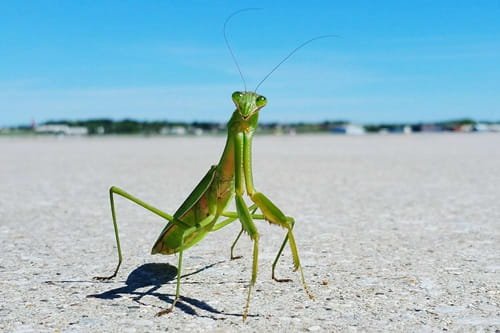
Part of what keeps this rumor alive is the mantis’s genuinely unusual appearance and its reputation as a beneficial garden predator. Mantises eat aphids, caterpillars, grasshoppers, and other insects that damage crops and gardens, which has earned them a strong reputation among gardeners and farmers as natural pest control. It’s an easy logical leap from “this insect is helpful and interesting” to assuming it must carry some kind of official protection, even though that leap doesn’t hold up legally. Gardening guides and environmental educators actively encourage people to leave mantises alone specifically because of this ecological value, but encouragement from a gardening blog is a completely different thing from an actual law passed by a legislature.
What About National Parks and Protected Areas
A reasonable follow-up question involves whether killing a mantis inside a national park or other protected natural area changes anything. Most national parks and protected areas do have general rules against harming wildlife, and these rules can technically extend to insects in some interpretations. That said, it would be genuinely unusual to find a specific park regulation naming the praying mantis directly or attaching a citation specifically to harming one. This scenario remains largely theoretical rather than something documented in actual enforcement records.
Some Confusion Around State-Level Rumors
Online forums occasionally circulate claims that specific states, like Ohio, have individual laws protecting mantises or walking sticks. These claims appear to be secondhand rumors passed between hobbyists rather than anything traceable to an actual statute. Anyone researching this seriously and checking state agricultural or wildlife codes directly has consistently come up empty-handed, reinforcing that this remains a myth rather than a patchwork of scattered state-level protections.
The Better Reason to Leave Them Alone Anyway
Even without any legal requirement, there’s a genuinely good practical case for not killing praying mantises when you encounter them. They’re harmless to humans, don’t bite or carry venom, and function as a completely natural pest control system that reduces the need for chemical pesticides in gardens and small farms. For anyone managing a vegetable garden or flower bed, a resident mantis population quietly working through aphids and caterpillars is arguably more useful left alone than removed, regardless of what the law does or doesn’t say about it.
FAQs
Q1. Will I get fined if a police officer or wildlife official sees me kill a praying mantis?
No. There is no law anywhere in the US establishing any fine or penalty for killing a praying mantis, so no citation or fine would ever be issued for this specific act.
Q2. Is there any insect that actually is illegal to kill in the United States?
Yes, several species protected under the Endangered Species Act, such as certain butterflies and specific beetle species, do carry real legal protection. The praying mantis has never been included on any such list.
Q3. Does the myth about a fifty-dollar fine come from any real historical law that was later repealed?
No credible source has ever traced this specific fine to an actual law that once existed. It appears to be a rumor that started circulating in the 1950s without any documented legal basis at any point.
Q4. Could killing a praying mantis in a national park lead to any consequences?
It’s highly unlikely in practice. While parks generally have wildlife protection rules, there’s no documented case of a specific citation being issued for harming a mantis, and no park regulation names this species directly.