There’s No Federal Rule Here at All
This question splits cleanly into two very different answers depending on where the smoking happens, and neither one starts with federal law, because there isn’t any. Congress has never passed a national statute addressing secondhand smoke exposure to children in homes or vehicles. Everything that follows is state-by-state, which means the honest answer to “is this illegal” always comes back to “depends on your zip code.”
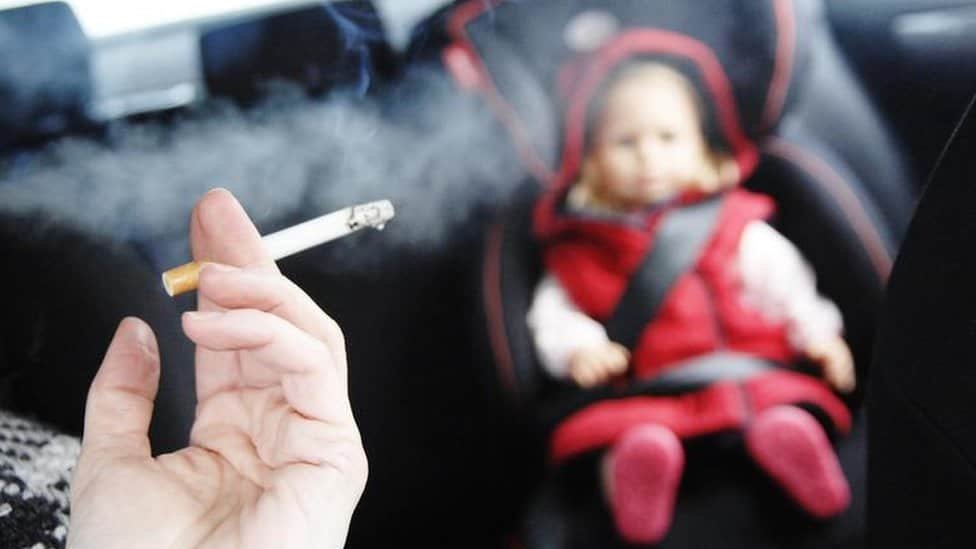
Inside Your Own Home, You’re Almost Entirely in the Clear
If you’re smoking in your own private residence around your own children, no state criminalizes this directly as a standalone offense. This surprises a lot of people, given how aggressively public health messaging treats secondhand smoke exposure to kids. The legal system draws a real distinction between discouraging harmful behavior and criminalizing it; parental smoking habits inside a private home generally fall under the same broad parental discretion that covers plenty of other legal-but-not-ideal choices, unless it becomes part of a larger pattern cited in a child neglect or custody proceeding.
Cars Are Where the Actual Laws Live
This is where things genuinely change. Twelve states, Alabama, Arkansas, California, Delaware, Illinois, Louisiana, Maine, Oregon, Utah, Vermont, Virginia, and West Virginia, along with Guam, the Northern Mariana Islands, and Puerto Rico, have passed laws specifically prohibiting smoking in personal vehicles when children or adolescents are present. These laws exist because a moving vehicle is an enclosed space a child genuinely cannot escape from, unlike a house with rooms, doors, and open windows a child could theoretically move away from.
Why the Age Cutoff Changes Everything About Whether You’re Breaking the Law
Here’s the detail that trips up parents driving across state lines. Each state sets its own age threshold for what counts as a protected minor passenger, and these numbers vary considerably. Arkansas draws its line at under 14. California extends protection all the way to under 18. Louisiana sets the cutoff at under 13. This means the exact same scenario, an adult smoking with a 15-year-old in the backseat, is a citation-worthy violation in California and completely legal in Arkansas, purely because the two states chose different ages to protect.
What Actually Happens If You’re Caught
Penalties for violating these vehicle smoking laws tend to be modest compared to other traffic offenses, typically structured as a fine rather than points on your license or anything approaching a criminal record. New York’s proposed version of this law, for example, set the penalty at no more than $100 per violation. Most existing state laws follow a similar pattern: enforceable, real, but calibrated more like a seatbelt fine than a serious criminal matter, reflecting that lawmakers designed these statutes around public health deterrence rather than harsh punishment.
Why Some States Went the Opposite Direction Entirely
Not every state has moved toward restriction. Five states, Colorado, Delaware, Indiana, Maryland, and Pennsylvania, along with Washington D.C. and the U.S. Virgin Islands, have laws that specifically exempt personal vehicles from broader state smoking restrictions altogether. This means in these jurisdictions, lawmakers considered and explicitly rejected extending workplace or public smoking bans into private vehicles, treating a personal car as private space regardless of who’s riding inside it.
Childcare Vehicles Follow an Entirely Separate, Stricter Standard
Set aside personal family vehicles for a moment, because licensed childcare transportation operates under its own distinct rules almost everywhere. Thirteen states plus several territories prohibit smoking in vehicles used specifically to transport children under formal childcare supervision, regardless of whether that same state has any personal vehicle restriction at all. Maine goes even further here than anywhere else in the country, requiring home-based childcare facilities to keep transport vehicles smoke-free for a full 12 hours before children are scheduled to ride in them, recognizing that lingering smoke residue and particles remain a genuine health concern long after the actual cigarette is finished.
The Health Reasoning Behind Why Cars Specifically Got Targeted
Public health agencies have been fairly direct about why vehicles became the primary legislative target rather than homes. Even with a window cracked or a vent open, the concentration of secondhand smoke particles inside a moving car remains at least twice the recommended 24-hour exposure limit set by federal environmental standards. With windows fully closed, the exposure level climbs high enough to be considered a serious health risk for anyone inside, not just children specifically. For infants and young kids in particular, this level of exposure has been linked to sudden infant death syndrome, increased respiratory and ear infections, and triggered asthma attacks, which is precisely the kind of concrete, documented harm that gave state legislatures a clear public health justification for regulating vehicles specifically rather than private homes broadly.
Why This Area of Law Keeps Actively Changing
This isn’t settled, static law the way something like basic traffic signals are. Legislative activity around vehicle smoking restrictions has picked back up in recent years, with states including New Jersey and Massachusetts introducing bills to either create new restrictions or expand existing age thresholds. Neither had passed as of early 2026, but the trend line across the country points toward more states adopting these laws over time rather than fewer, following the same pattern that’s played out with other child-safety vehicle regulations like car seat requirements over the past few decades.
What This Means If You Regularly Drive Across State Lines
Given how much these specific age thresholds and restrictions vary, the safest practical approach for anyone who regularly drives through multiple states with children in the car is simply treating every vehicle trip as smoke-free by default. This sidesteps the genuinely confusing patchwork entirely rather than requiring you to track which specific state you’re currently driving through and what age cutoff applies there at any given moment.
FAQs
Q: If my state has no law restricting smoking in cars with kids, am I completely free to do it without any legal risk at all?
A: In terms of a standalone smoking-specific citation, yes, though this could still factor into a broader child welfare or custody case if a court is already examining a parent’s overall judgment and care decisions for unrelated reasons.
Q: Does vaping fall under the same restrictions as traditional cigarette smoking in these state vehicle laws?
A: It depends on the specific state’s statutory language, since some laws explicitly include vaping and e-cigarettes while others were written before vaping became widespread and may only reference traditional smoking directly.
Q: Can a police officer pull me over specifically because they saw me smoking with a child in the car?
A: In states with an active restriction, yes, this can serve as independent grounds for a stop and citation, separate entirely from any other traffic violation or driving behavior.
Q: Do these vehicle smoking laws apply if the car is parked rather than actually being driven?
A: Most state statutes are written broadly enough to cover the vehicle itself rather than only while it’s in motion, so a parked car with a child inside would generally still fall under the same restriction where one exists.