Kissing in public in India exists at the intersection of legal ambiguity, social diversity, and vigorous debate about personal freedom versus community standards. The direct answer: kissing itself is not explicitly criminalised anywhere in Indian law. No statute says “kissing in public is illegal.” However, if a kiss is deemed “obscene” by the prevailing community standards and causes “annoyance” to someone, it can be prosecuted under the public nuisance provisions of the Bharatiya Nyaya Sanhita, 2023. The distinction between a brief peck and a prolonged passionate display is crucial.
The Legal Framework: BNS Section 292/296
The Bharatiya Nyaya Sanhita (BNS), 2023, which replaced the IPC from July 2024, contains the key provisions. Section 292 (replacing IPC Section 294) deals with public nuisance, including public indecency. Section 296 specifically addresses obscene acts in public places: “Whoever, to the annoyance of others, (a) does any obscene act in any public place, or (b) sings, recites, or utters any obscene song, ballad, or words, in or near any public place, shall be punished with imprisonment of either description for a term which may extend to three months, or with fine up to Rs 1,000, or with both.”
Three conditions must ALL be present for an offence: the act must be “obscene”; it must occur in a “public place”; and it must cause “annoyance to others.” The absence of any one of these elements means no offence. “Obscene” is not defined in the BNS, which the Supreme Court has noted is a “delicate task” left to courts. The critical legal question in any kissing case is always: was this specific act obscene by contemporary community standards?
The Community Standards Test: What Makes Something Obscene?
India moved away from the colonial-era Hicklin Test (based on effect on “most susceptible minds”) to the Community Standards Test, most clearly established in Aveek Sarkar v. State of West Bengal (2014). Obscenity is now judged by contemporary societal standards, taking into account: the nature of the act (degree of sexual explicitness); the context (intimate vs gratuitous); the location (private corner vs crowded public space); the intention; and current social norms in the community.
The Supreme Court has consistently held that “notions of social morality are inherently subjective and criminal law cannot be used as a means to unduly interfere with the domain of personal autonomy.” Brief, contextual expressions of affection – a kiss between partners – are very unlikely to meet the legal threshold of “obscene” under the Community Standards Test in 2026.
Landmark Cases Shaping the Law
The Richard Gere-Shilpa Shetty case (2007): At an AIDS awareness event, Hollywood actor Richard Gere kissed actress Shilpa Shetty on the cheek, leading to FIRs under IPC Section 294. The Supreme Court dismissed the complaints, observing that no case was made out. Despite this definitive Supreme Court observation, the Bombay Magistrate Court still issued warrants, demonstrating how inconsistently the law is applied in practice.
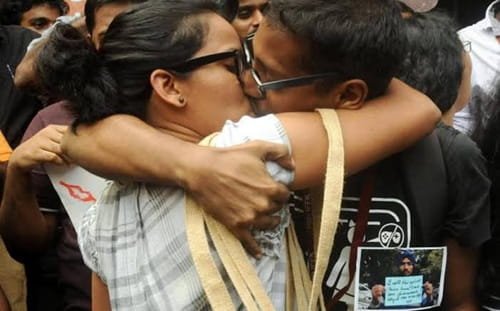
Kiss of Love Protests (2014): In Kerala, the “Kiss of Love” movement emerged as a protest against moral policing. Protesters kissed publicly to challenge conservative groups who were attacking couples in parks and public spaces. The protests led to arrests and nationwide debate. The Kerala High Court declined to prohibit the protests, recognising them as political expression.
Delhi Metro viral video (2023): A couple kissing in Delhi Metro triggered widespread social media debate and DMRC announced increased surveillance. The incident shows how social enforcement and institutional responses exist independently of formal law.
Madras High Court (2024): The Court emphasised that the determination of obscenity must consider context, consent, and contemporary community standards, and that minor displays of affection cannot be treated as obscene without proper legal analysis.
Moral Policing: The Extra-Legal Reality
Beyond the formal law, India has a persistent “moral policing” phenomenon where groups like Bajrang Dal, right-wing organisations, or self-appointed community guardians physically attack couples who display affection in public. Valentine’s Day and other occasions see periodic incidents where couples are harassed, beaten, or forced to perform “apologies.”
This extrajudicial vigilantism is itself illegal under the BNS (criminal intimidation, assault, unlawful assembly) and multiple courts have condemned it. Victims of moral policing can: file FIRs against their attackers for criminal intimidation and assault; seek protection orders from the High Court under Article 226; and file civil suits for damages. The Supreme Court has repeatedly stated that police must protect individuals from moral policing rather than participate in it.
Practical Guidance
A brief, contextual kiss in a genuinely private corner of a public space is very unlikely to result in any legal consequence. Prolonged passionate displays that draw complaints from others in a crowded public space cross into the grey area where prosecution is possible. Avoid locations that are culturally sensitive (near temples, schools, etc.). If you are harassed by moral police, call 112 for emergency police, clearly state you are being assaulted, and document the incident on video if possible. You cannot be arrested for a brief expression of affection – if police attempt to do so, ask for the specific legal provision being invoked and request to speak to a senior officer or lawyer.
Final Thought
Kissing in public is not explicitly illegal in India. The applicable law requires the act to be “obscene” (judged by contemporary community standards), take place in a public setting, and cause “annoyance to others.” A brief kiss between consenting adults is very unlikely to meet this threshold under current judicial interpretation. The deeper reality is that enforcement is inconsistent and socially influenced rather than legally principled, creating unpredictable risk particularly in smaller cities and conservative areas. The law supports individual freedom; moral policing does not have legal sanction. Know your rights, exercise discretion based on your environment, and seek police protection if you face unlawful harassment.
Frequently Asked Questions (FAQs)
Q1. Can I be arrested for kissing my girlfriend/boyfriend in a park?
A brief kiss in a park is very unlikely to result in arrest. For BNS Section 296 to apply, the act must be “obscene” (which a brief kiss is not under the Community Standards Test) AND cause “annoyance to others.” The Supreme Court dismissed charges in the Richard Gere case for similar acts. However, if police are called by a complainant, they may ask you to leave or may even detain you. The offence under Section 296 is a bailable offence – you cannot be detained indefinitely, and the maximum penalty is 3 months imprisonment or Rs 1,000 fine. Immediately contact a lawyer if detained.
Q2. What can I do if moral police or vigilante groups attack me for kissing in public?
You have full legal protection. The vigilantes are committing assault, criminal intimidation, and possibly unlawful assembly – all criminal offences under the BNS. Immediately call 112. Record video evidence if safe to do so. File FIR against the attackers at the nearest police station. If police are unresponsive, approach the nearest Magistrate or file a petition in the High Court under Article 226. The Supreme Court has repeatedly held that police must protect individuals from extrajudicial moral policing.
Q3. Is PDA (Public Display of Affection) illegal in India?
PDA is not categorically illegal in India. Its legality depends on the degree and context. Holding hands, hugging briefly, and kissing on the cheek in public are not obscene acts by any reasonable legal standard. Prolonged intimate behaviour that explicitly causes annoyance to surrounding members of the public could technically attract Section 296 BNS, but police discretion and actual complaints are necessary for any action. The law has no blanket prohibition on PDA – the requirement that the act be “obscene” and cause “annoyance” is a high bar for brief affectionate behaviour.
Q4. Which public places are most legally sensitive for PDA in India?
Areas near places of worship (temples, mosques, churches), educational institutions, and government buildings are areas where sensitivity to community standards is highest and where cultural expectations of decorum are strongest. Isolated spaces like late-night parks, dark corners, or spaces that become semi-private (despite being technically public) are where complaints are less likely but where safety concerns may apply. Urban commercial spaces like malls and cinema lobbies in metropolitan cities generally have more relaxed social norms and legal enforcement.
Q5. Has any court ever actually convicted someone for kissing in public?
Very few documented convictions exist solely for the act of kissing between consenting adults in public, and none at the higher court level. The Supreme Court dismissed the Richard Gere complaint. Most lower court cases involving PDA are disposed of during investigation or at the magistrate level without conviction. When prosecuted, fines rather than imprisonment are typically imposed. The legal risk is more about the harassment, detention, and social consequences during the investigation process than about ultimate conviction.