Turtles and tortoises are popular pets in India, often associated with good luck and longevity in Hindu and Chinese traditions. However, most Indian turtle and tortoise species are strictly protected under the Wild Life (Protection) Act, 1972, making it illegal to own, trade, or keep them as pets. The key distinction that determines legality is whether the species is native to India or exotic (non-native). Understanding this distinction can be the difference between a legal pet and a criminal prosecution.
The Wild Life (Protection) Act, 1972 and Its 2022 Amendment
The Wild Life (Protection) Act, 1972 is the primary legislation protecting India’s wildlife, including turtles and tortoises. The WPA has been amended multiple times – significantly in 2022 – to add more species to protection schedules and increase penalties. Under the WPA, wild animals listed in Schedules I through IV are protected from: capture, killing, or harming; trade, purchase, or sale; transportation; keeping as pets without authorisation; and any form of commercial exploitation.
The 2022 amendment specifically strengthened protections for turtle and tortoise species, moving many from lower to higher schedules, providing them the same level of protection as tigers. This means that possessing certain turtle species that were previously in lower-protection schedules now attracts the severest penalties under the Act.
Indian Star Tortoise: The Most Common Illegal Pet
The Indian Star Tortoise (Geochelone elegans) is the most commonly encountered turtle species in Indian illegal pet markets. Found across peninsular India and Sri Lanka, its beautiful star-shaped shell pattern makes it highly desirable for the pet trade both domestically and internationally.
Legal status: The Indian Star Tortoise is listed under Schedule IV of the WPA. Possessing an Indian Star Tortoise can lead to criminal charges with imprisonment up to six months and fine up to Rs 25,000. In 2019, international commercial trade in Indian Star Tortoises was banned when the species was added to Appendix I of CITES (Convention on International Trade in Endangered Species of Wild Fauna and Flora), prohibiting international commercial trade entirely. India is the primary source country for star tortoise smuggling to Southeast Asia, Europe, and the United States.
Despite these protections, star tortoises are commonly sold openly in markets and pet shops in many Indian cities. The enforcement gap is significant – buyers often purchase them unknowingly, not realising they are committing a crime. If you currently own an Indian Star Tortoise, consult a wildlife lawyer or approach your local forest department for guidance on voluntary surrender without prosecution.
All Native Indian Turtle and Tortoise Species Are Protected
Beyond the Indian Star Tortoise, ALL turtle and tortoise species native to India are protected under the WPA. Protected native species include: Indian Tent Turtle (Pangshura tentoria); Indian Flapshell Turtle (Lissemys punctata); Indian Softshell Turtle (Nilssonia gangetica); Black Pond Turtle (Geoclemys hamiltonii); Roofed Turtle (various Pangshura species); Sea Turtles (all five species found in Indian waters – Olive Ridley, Green, Hawksbill, Leatherback, Loggerhead); and Freshwater Turtles (Indian Roofed Turtle, Assam Roofed Turtle, etc.).
Keeping any of these species as pets is illegal. The penalty depends on the schedule under which the species is listed: Schedule I species attract the highest penalties (3-7 years imprisonment); other schedules have lower but still significant penalties. If convicted: fine of more than Rs 25,000 and jail time up to 7 years for Schedule I species; up to 6 months and Rs 25,000 fine for Schedule IV species like the Star Tortoise.
Exotic (Non-Native) Turtles: The Legal Grey Area
A legal pathway exists for exotic tortoise species not native to India. Since the WPA’s prohibition focuses on protecting India’s indigenous wildlife, non-native species do not fall directly under its prohibitions. The rationale: possessing an exotic tortoise does not deplete India’s native wildlife populations.
Potentially legal exotic species (when acquired legally): Sulcata Tortoise (African Spurred Tortoise, Centrochelys sulcata) – native to Africa’s Sahel region; Red-Footed Tortoise (Chelonoidis carbonarius) – native to South America; Elongated Tortoise – when from captive-bred sources outside India; and Russian Tortoise.
However, there are important caveats. You must have documentation proving the tortoise’s non-Indian origin (import permits, CITES documentation for CITES-listed species, and proof of legal acquisition from captive breeding). An exotic tortoise brought into India must have cleared customs with proper import documentation. Without such documentation, even an exotic species could be presumed to be an illegally obtained native species by authorities.
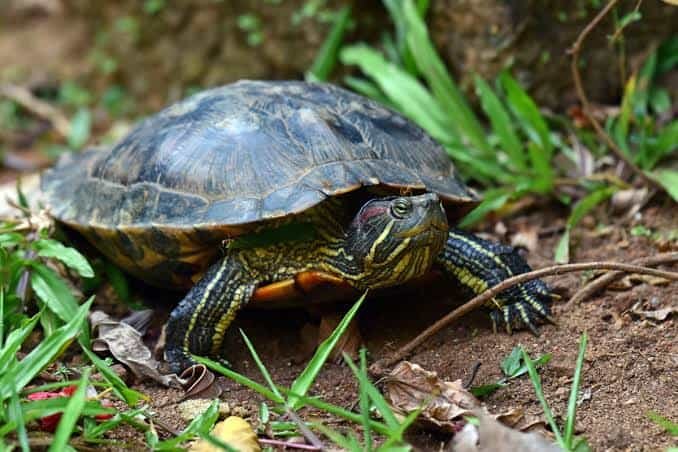
The Red-Eared Slider (Trachemys scripta elegans), a North American aquatic turtle commonly sold in Indian pet shops, occupies a complex position. While it is non-native, it is an invasive species that threatens native turtle populations when released. Some states have restricted its sale because released sliders can outcompete native turtles. Never release any pet turtle into natural water bodies.
How to Report and What to Do With an Illegally Obtained Turtle
If you discover you unknowingly own a protected native turtle species, the best course of action is to voluntarily surrender it to the local Forest Department or a Wildlife SOS rescue centre. Voluntary surrender generally does not lead to prosecution. Keeping a known protected species risks charges under the WPA.
Report suspected illegal turtle trade to: Wildlife Crime Control Bureau (WCCB): wccb.gov.in; National Anti-Poaching Helpline: 1800-11-4488; Wildlife SOS: wildlifesos.org; and local Forest Department. Photos, videos, and location information are helpful for enforcement action.
Final Thought
Native Indian turtles and tortoises are firmly protected under the WPA, 1972, and cannot legally be kept as pets. This includes the commonly sold Indian Star Tortoise. Exotic (non-native) tortoise species with proper import documentation occupy a grey area that may be legally permissible, but requires documentation proving origin and legal acquisition. The practical advice: do not purchase turtles from street vendors, markets, or pet shops that cannot provide CITES certificates and import documentation. Consider legal, non-protected pets instead. India’s turtle populations face severe pressure from illegal trade – every purchase of a protected turtle funds the criminal networks that are pushing these species toward extinction.
Frequently Asked Questions (FAQs)
Q1. Is it legal to keep a tortoise at home for good luck (vastu/feng shui)?
If the tortoise is a protected native Indian species (including the commonly sold Indian Star Tortoise), it is illegal regardless of the reason for keeping it. The WPA does not have an exemption for religious, cultural, or vastu purposes. If you want a symbolic turtle for good luck, opt for decorative turtle statues (marble, brass, crystal) which are completely legal and widely available, or an exotic non-native species with proper documentation. If you already own a protected species, consider voluntary surrender to the Forest Department.
Q2. What should I do if I find an injured turtle?
Do not keep it. Contact your local Forest Department, Wildlife SOS (wildlifesos.org), or any authorised wildlife rescue centre immediately. Provide the location and describe the turtle’s condition. Keep it in a cool, shaded place temporarily if the rescue will take time, but do not put it in water if you are unsure of its species (some are strictly terrestrial). Even well-intentioned keeping of an injured protected species without forest department authorisation can technically constitute illegal possession.
Q3. I bought a turtle from a pet shop – what should I do?
First, photograph the turtle and search online to identify the species. If it is a native Indian species (most likely if bought from a street market or unregistered pet shop without documentation), it is a protected species being illegally traded. The safest legal course is voluntary surrender to the Forest Department – most forest officers are understanding with people who cooperate. If it is a clearly exotic species and you have purchase documentation from the shop, keep that documentation safely. Never release the turtle into natural water bodies – this is both ecologically harmful and could itself attract legal attention.
Q4. Can I legally import a tortoise from abroad to keep as a pet in India?
In principle, yes for non-CITES listed non-native species with proper import documentation. However, all live animal imports require: CITES permit (if the species is CITES-listed); import permit from DGFT (Directorate General of Foreign Trade); phytosanitary/veterinary clearance; and compliance with Customs Act requirements at point of entry. Many tortoise species are CITES Appendix I or II listed, making legal commercial import extremely difficult. Consult a specialist wildlife and customs law attorney before attempting to import any tortoise.
Q5. Is the Red-Eared Slider turtle legal to keep as a pet in India?
The Red-Eared Slider (RES) is a North American species, not native to India, placing it outside the WPA’s direct protection framework. It is commonly sold in Indian pet shops and is generally legal to keep. However: some states have restricted its sale due to its invasive nature; never release a RES into Indian water bodies – it outcompetes native turtles; and you may need to prove its non-Indian origin if questioned by authorities. Look for a shop that provides documentation of the turtle’s origin and captive-breeding background.