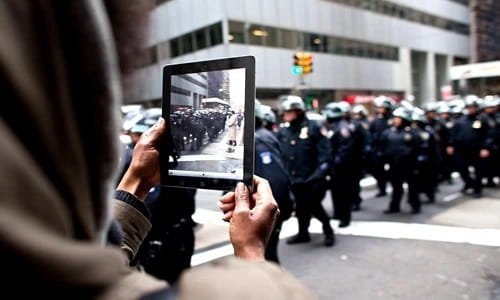
In the smartphone age, the question of whether you can film a police officer while they are on duty has taken on enormous civic importance. Videos of police conduct — both lawful and unlawful — regularly go viral and have led to accountability, investigations, and convictions. India’s legal framework, while not containing a specific ‘right to record police’ statute, supports the citizen’s right to document police action in public through constitutional provisions, judicial precedent, and state-level legislation.
The Constitutional Foundation
Article 19(1)(a) of the Indian Constitution guarantees the right to freedom of speech and expression. Courts have interpreted this broadly to include the right to gather, document, and disseminate information — which encompasses recording events in public spaces including police activities. Article 21 guarantees the right to life and liberty, which the Supreme Court has interpreted to include the right to know and access information about public institutions. Transparency and accountability in public services are considered essential aspects of Article 21’s protection.
The Supreme Court’s Right to Privacy judgment (Justice K.S. Puttaswamy v. Union of India, 2017) clarified an important nuance: while privacy is a fundamental right, a police officer’s acts performed in the course of their official public duties are not protected by the right to privacy. Public servants acting in their official capacity cannot claim privacy protection for those official acts. A police officer making an arrest or conducting a challan proceeding in public cannot prevent you from documenting that act on the grounds of privacy.
Key Legal Provisions Relating to Recording
Section 186 BNS (formerly IPC Section 186): Obstructing a public servant in the discharge of public functions is an offence punishable with imprisonment up to 3 months or fine up to Rs 500. This provision is critical: if your act of recording physically obstructs the police officer from performing their duty — blocking their movement, creating a crowd, preventing an arrest — you can be charged under this section regardless of your recording intention.
Section 353 IPC/BNS: Using criminal force or assault to deter a public servant from duty is a more serious offence. If recording escalates into a physical confrontation, this section applies.
The key principle derived from both sections: recording itself is not obstruction. What makes an act obstruction is physical interference with the officer’s ability to perform their duty. Standing at a safe distance, not touching or impeding the officer, not creating a crowd disturbance, and simply documenting what you see is not obstruction under either section.
Landmark Judicial Positions
Kolkata High Court (2008): In a foundational ruling, the Court held that a police officer cannot seize a citizen’s phone merely because it contains recordings of them. This judgment established that recording police officers is not inherently illegal and that police have no automatic right to confiscate devices containing such recordings.
Bombay High Court: Ruled that filming inside police stations is not an offence under the Official Secrets Act, 1923. Recording within a police station in circumstances that are not operationally sensitive is permissible.
Kerala Police Act, 2011 — Section 33(2): This provision is uniquely progressive. It explicitly states that no police officer shall prevent any person from recording their activities in public or private spaces, provided the recording does not obstruct their duties. This is the only state law in India that affirmatively codifies the citizen’s right to record police, making the right explicit rather than merely inferred.
BNSS (Bharatiya Nagarik Suraksha Sanhita), 2023 reform: The BNSS mandates that for certain arrests and search-and-seizure operations, the police themselves must create audio-video recordings. This affirmative obligation on police to document their own activities further normalises and legitimises the culture of recording police action.
When Recording Can Become Legally Risky
Recording becomes legally problematic when: it physically obstructs the officer (Section 186 BNS); it occurs during sensitive operations like counter-terrorism raids, undercover operations, or operations requiring operational secrecy where disclosure of police tactics endangers lives or ongoing operations; it occurs in areas where photography is explicitly prohibited (military zones, certain government installations, airports during security operations); it is done with a declared intent to intimidate or interfere rather than document; or when recordings are subsequently used for blackmail, defamation, or to spread false narratives about the police (separate offences under BNS and IT Act).
Official Secrets Act, 1923: Cannot be used to prevent recording of police activities in ordinary public spaces, but applies to genuinely restricted government areas.
Practical Guidance for Citizens
How to record police safely and legally: Stay at a safe distance — do not enter the officer’s operational perimeter. Do not touch, push, or physically impede the officer in any way. Do not create a crowd or incite others to obstruct. If asked to move further away for operational safety, comply while continuing to record from the new distance. Clearly identify yourself if asked and state that you are documenting public activities. Do not delete the recording if a police officer demands it without legal process — the Kolkata HC ruling protects your right to retain recordings of police activities. Store recordings securely — upload to cloud storage as soon as possible.
If police demand your phone or deletion of recordings: calmly state that you are within your constitutional rights under Article 19 and Article 21; ask for the specific legal provision under which confiscation is demanded; do not physically resist confiscation (this can become an obstruction charge), but note the officer’s name and badge number; file a complaint with the State Human Rights Commission, Police Complaints Authority, or approach a High Court if your recording is unlawfully seized.
Final Thought
Recording police officers on duty in public is legal in India. The right is grounded in Articles 19 and 21 of the Constitution, affirmed by High Court judgments, explicitly codified in Kerala, and implicitly supported by the BNSS’s own recording mandates. The limits are clear: do not obstruct, do not interfere, do not endanger ongoing operations. The ability of citizens to document police conduct is one of the most important accountability tools in a democracy — use it responsibly, stay safe, and know your rights.
Frequently Asked Questions (FAQs)
Q1. Can a police officer tell me to stop filming them?
An officer may ask you to move back or stop filming, but they have no absolute legal right to prohibit recording of their public activities. The Kolkata High Court held that officers cannot seize phones merely for containing recordings of them. Kerala Police Act Section 33(2) affirmatively states officers cannot prevent such recording. You can comply with a request to move back for safety reasons while continuing to record from a safe distance. Do not delete recordings if demanded — this is not a lawful police instruction under general law.
Q2. What should I do if police try to delete my video?
Do not physically resist deletion attempts — this risks an assault or obstruction charge. If police physically take your phone and delete recordings, this is likely an unlawful act and you should: immediately note the officer’s name, badge number, and station; file a complaint with the State Police Complaints Authority; approach the relevant State Human Rights Commission; and consider filing a petition before the High Court. Upload your recordings to cloud storage immediately after capturing them so local deletion does not destroy the evidence.
Q3. Is it legal to film inside a police station?
The Bombay High Court ruled that filming inside police stations is not an offence under the Official Secrets Act, 1923 in ordinary circumstances. However, this does not mean unrestricted filming inside stations — police can impose reasonable operational restrictions. Areas related to ongoing sensitive investigations, lock-ups, and evidence rooms are areas where restrictions would be reasonable. In general, documenting your own interaction with police at a station (e.g., filing an FIR) is not illegal, though you should exercise discretion about recording other individuals who may have privacy interests.
Q4. Can I record an encounter where police use excessive force?
Yes. Recording police using excessive force is precisely the most important use of a citizen’s right to document public officials. Stay safe — do not enter the operational area. Record from a distance. Upload immediately to cloud storage. Preserve the original unedited recording. Share with credible media, human rights organisations, or legal counsel. Such recordings can be admitted as evidence in legal proceedings (with appropriate Section 63 BSA certification) and have been instrumental in multiple cases where police misconduct was established before courts and independent commissions.
Q5. Can I be arrested just for recording police?
No, not for the act of recording alone. There is no law that makes recording police in a public place a standalone criminal offence. However, if you are simultaneously obstructing the officer (Section 186 BNS), assaulting them (Section 352 BNS), or your behaviour creates a public order problem, arrest becomes possible — not for recording, but for the accompanying conduct. Police sometimes make unlawful arrests of people recording inconvenient incidents. If arrested unlawfully, immediately invoke your right to legal counsel, contact a lawyer, and apply for bail. File a habeas corpus petition before the High Court if detained without lawful cause.