With India’s scorching summers and intense UV radiation, sun shades and window films are among the most sought-after car accessories. Yet the Supreme Court of India issued a decisive ruling in 2012 that significantly restricted what you can and cannot place on your car’s windows. The result is a genuine confusion: millions of cars have sun shades, police in different states enforce differently, and a 2024 Kerala High Court ruling added a new legal dimension. Here is the definitive legal position.
The Supreme Court’s 2012 Ruling: The Foundation
In Avishek Goenka v. Union of India (2012), the Supreme Court of India issued a landmark ruling that banned the use of all aftermarket black films, tints, or any other material pasted on car windows. The ruling was motivated by documented criminal activity inside vehicles with heavily tinted windows — the court found that tinted glass hindered law enforcement’s ability to see inside vehicles, facilitated criminal acts, and impaired drivers’ visibility, particularly at night or in low-light conditions. The Supreme Court’s ruling has the force of law throughout India under Article 141 of the Constitution — it applies in all states and overrides any state-level variation. The court’s specific direction: ‘No black film of any percentage of visual light transmission shall be used on the front windscreen and side windows of any motor vehicle.’
The key phrase is ‘any percentage of VLT’ — meaning even a transparent film that minimally reduces light transmission is covered by this ban when it is an aftermarket application. The ruling applies to all pasted/applied materials, not to factory-fitted glass.
CMVR Rule 100: The Technical Standard
The Central Motor Vehicles Rules, 1989, Rule 100(2) sets VLT (Visual Light Transmission) standards for vehicle glass: Windscreen (front and rear): minimum 70% VLT. Side windows: minimum 50% VLT. These standards apply to glass as manufactured by vehicle manufacturers. Factory-fitted tinted glass that meets these VLT thresholds is legal. However, after the Supreme Court’s 2012 ruling, the VLT standard from Rule 100 is relevant for factory glass only — not for aftermarket films, because all aftermarket films are banned regardless of their VLT rating.
What Is Legal and What Is Illegal
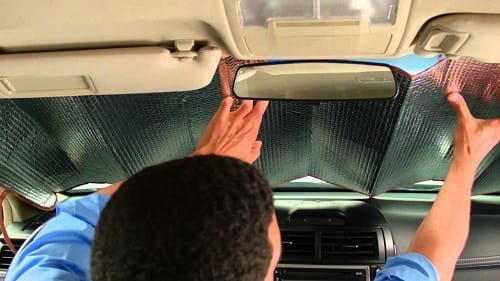
Clearly legal: Factory-fitted/OEM tinted glass meeting the 70%/50% VLT standards. Sun control glass offered by manufacturers as a factory option (like Maruti’s Monsoon Glass, available in some models). Removable external sun visors that clip to the top of the window frame and do not obstruct the driver’s view — these are not ‘pasted’ materials and are generally considered permissible when the vehicle is in motion (check specific state enforcement). Sunshades placed on the inside of windows when the vehicle is PARKED — removing them before driving is essential. Reflective dashboard covers to block sun from the parked interior.
Clearly illegal: Any aftermarket tinted film — dark, medium, or light — pasted or applied to any window. Black curtains installed on rear passenger windows. Bubble wrap or foil applied to glass. Any form of fixed sun-blocking material attached to or on the glass surface. Privacy films or frosted films, even if they meet VLT technically — they are still ‘applied materials’ banned by the SC ruling.
Kerala High Court 2024: A New Dimension
In M/s. George & Sons v. Union of India (September 2024), the Kerala High Court issued a judgment that appeared to create space for VLT-compliant films under the Bureau of Indian Standards’ new IS 2553:2019 standard for safety glazing. The court reasoned that if a film, when combined with the car glass, meets the 70%/50% VLT standard, it could be permissible under the safety glazing standard. However, this Kerala HC ruling creates a direct conflict with the Supreme Court’s 2012 absolute ban on ‘any applied material.’ Under Article 141 of the Constitution, the Supreme Court’s ruling takes precedence over any High Court interpretation. As of 2025, the Kerala HC ruling applies only within Kerala as a first instance ruling and is subject to appeal. Outside Kerala, and formally even within Kerala, the SC’s 2012 ban remains the binding national law. The MoRTH has not yet amended the CMVR to reflect the IS 2553:2019 standard.
Enforcement and Penalties
Traffic police and RTO enforcement for illegal window films has been intensified in multiple cities. Penalty range: Rs 500 first offence under MVA Section 177. Rs 1,500 for subsequent offence. Rs 5,000 under MVA Section 182A(4) for illegal vehicle modification. Police can also demand removal of the film on the spot. Licence suspension is possible for repeat violators. State-level enforcement varies significantly — Delhi, Karnataka (Bengaluru), and Maharashtra have more active enforcement drives. Kerala has had some enforcement uncertainty following the 2024 HC ruling, but the national law remains the SC’s 2012 ban.
Final Thought
The legal position on car sun shades in India is primarily governed by the Supreme Court’s 2012 ruling in Avishek Goenka: all aftermarket films and applied materials on car windows are illegal, regardless of their VLT percentage. Factory-fitted tinted glass meeting CMVR Rule 100 standards is legal. Removable external clip-on visors that do not obstruct the driver’s view are generally tolerated, but remove them while driving for caution. India’s brutal summers make sun protection a genuine need — explore manufacturer-approved solutions, solar control glass options, and proper interior ventilation as legal alternatives to aftermarket films.
Frequently Asked Questions (FAQs)
Q1. Can I use a removable suction-cup sun shade on my rear windows while driving?
This is the most contested practical question. Suction-cup or clip-on sun shades that are not pasted or permanently adhered to the glass fall outside the literal scope of the SC’s ban on ‘pasted’ materials. Many car owners use them on rear side passenger windows and infant/child seats. The key condition: they must not obstruct the driver’s forward or lateral visibility; they must be easily removable; and they should not be on the driver’s side window or the front windscreen. Police in some states may still flag them under their reading of the SC ruling. The safest practice: use them when parked; remove them when driving.
Q2. Does factory-fitted tinted glass need to be changed?
No. Factory-fitted/OEM tinted glass installed by the vehicle manufacturer at the time of production is legal, provided it meets the CMVR Rule 100 VLT standards (70% front/rear windscreen, 50% side windows). The Supreme Court’s ban is specifically on ‘aftermarket films’ — materials applied post-purchase. If your car came from the factory with lightly tinted glass certified by the manufacturer, this is legal and does not need to be changed.
Q3. I have a medical condition (photosensitivity) — can I get an exemption for tinted windows?
Some states have provisions for medical exemptions where a person with documented photosensitivity or a specific medical condition requiring reduced light exposure can apply to the RTO for permission to use tinted glass or protective film. This requires: a medical certificate from a qualified doctor; application to the local RTO or state transport authority; and a specific endorsement on the vehicle’s RC (Registration Certificate). Medical exemptions are granted sparingly and are verified — a blanket self-declaration is insufficient. Check with your local RTO for the specific process in your state.
Q4. My car’s rear window has a factory-fitted sunshade blind (like in luxury cars) — is that legal?
Factory-fitted rear window blinds/roller shades built into the vehicle by the manufacturer (common in luxury cars like Mercedes, BMW, and Toyota Vellfire) are in a different legal category from aftermarket additions. These are factory-installed features, not ‘applied materials.’ When retracted, they present no visibility issue; when extended in the rear passenger area, they should not affect the driver’s primary field of vision. The legal risk is low for genuine factory-fitted rear blinds. However, aftermarket roller shades installed in a factory-style manner by dealers are still potentially in violation of the SC’s broad ruling.
Q5. What are the legal alternatives for keeping a car cool without window films?
Several effective and legal alternatives exist. Reflective windscreen covers (used only when parked, removed before driving): very effective at preventing the car’s interior from heating up. OEM solar control glass: factory-offered in some car models. Ceramic or nano-ceramic clear UV-blocking glass coatings: a legal grey area (not a traditional film, but still an applied material — check current state enforcement before using). Proper parking: shade trees, covered parking, and car covers. Ventilated parking: slightly cracked windows when parked. Air conditioning: pre-cooling with remote start if available. These alternatives address the heat management need without attracting traffic challans.