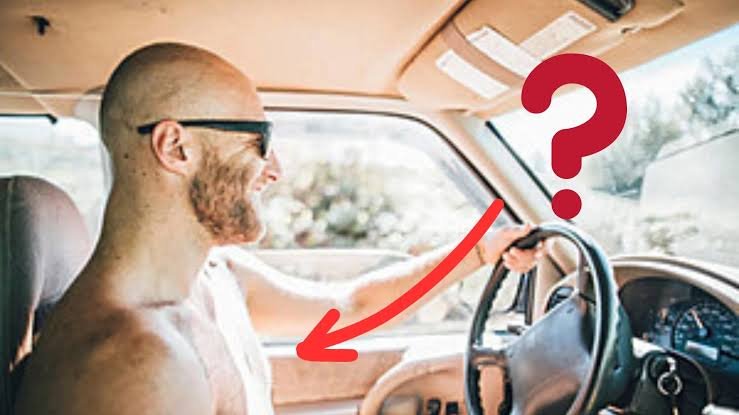
Search every vehicle code in the country, and you won’t find a single state that lists “driving without a shirt” as a traffic violation. This has been true consistently since traffic law began, and it remains true today; no legislature has ever passed such a bill, no state is currently considering one, and the reason is fairly simple once you think about it. Traffic law exists to address things that affect driving safety, and what fabric covers your torso has no bearing whatsoever on your ability to steer, brake, or react to road conditions.
Why Your Car Gets Treated Like a Private Space for This Purpose
Part of why this myth persists is that people instinctively assume public spaces come with dress requirements, and a vehicle sitting on a public road feels like it should count as public in that sense. But your car’s interior functions closer to a private space under most state legal frameworks, meaning what you’re wearing inside it rarely triggers traffic enforcement the way it might if you walked shirtless down a sidewalk in certain jurisdictions with stricter public conduct rules.
Why the Male-Female Distinction Actually Matters Here
This is where the topic genuinely does have legal texture worth understanding, rather than being a simple universal non-issue. The driving act itself is legal for everyone regardless of gender. But a small number of states, including Tennessee, Indiana, and Utah, maintain public indecency or exposure laws that treat female toplessness differently than a bare male chest, since these statutes are specifically written around exposure of genitals or, in certain states, female breasts. This means a topless woman driving through one of these particular states could theoretically face an indecent exposure inquiry in a way a shirtless man in the identical scenario simply wouldn’t, not because driving without a shirt is illegal for either of them, but because the underlying public decency statute itself draws a gendered distinction that has nothing to do with traffic law.
Why a Bare Male Chest Never Meets the Legal Bar for Indecent Exposure
It’s worth stating this plainly since it resolves a lot of unnecessary anxiety. Indecent exposure statutes across every state require exposure of specific body parts, genitals, and in some states, female breasts specifically. A bare male torso simply doesn’t fall within these legal definitions anywhere in the country. Picture a scenario where someone drives shirtless through a school zone and a passerby reports it as indecent exposure; that report wouldn’t hold up, since a bare male chest doesn’t meet the statutory threshold regardless of location or who happened to witness it.
Why an Officer Might Still Pull You Over Anyway
Here’s the nuance that keeps this from being a completely risk-free situation in every circumstance. Officers retain broad discretion to stop drivers for behavior they consider unusual or potentially distracting, and shirtless driving, while not itself illegal, can sometimes provide the kind of observed oddity that gives an officer a reason to initiate a stop, especially if combined with something else, erratic driving, visible distraction, or a genuinely unusual scene. The stop itself might get justified under a completely separate statute, careless driving or a public decency provision, rather than any charge actually naming the missing shirt.
Why Total Nudity Sits in a Genuinely Different Legal Category
It’s worth distinguishing shirtless driving clearly from actual nudity while driving, since these get conflated constantly. Complete nudity, exposing genitals, does raise real legal issues under indecent exposure, public lewdness, or disorderly conduct statutes, depending on the state. The critical factor courts look at is visibility to others; someone driving nude on an empty highway at 2 a.m. with tinted windows and nobody around to actually witness it generally hasn’t committed a completed offense, since most of these statutes require the nudity to actually be seen or witnessed by another person. The moment that same nudity becomes visible to someone else, a passing driver, a passenger, an officer during a stop, the legal analysis shifts considerably. In practice, an officer encountering a nude driver during a stop will typically ask them to cover up before proceeding, and cooperating with that request generally results in a warning rather than escalating toward an actual nudity-related charge.
Why Commercial Driving Introduces an Entirely Separate Set of Expectations
Federal regulations governing commercial drivers contain no explicit dress code mandating shirts. That said, virtually every trucking company and commercial employer maintains its own internal professional attire policy requiring shirts as a matter of company standard, entirely separate from any government requirement. Independent owner-operators running their own rigs have more flexibility to set their own personal dress standards, though even they typically consider client and broker expectations that can informally shape what they choose to wear on the job regardless of what any actual law requires.
Why Rideshare Platforms Add Their Own Layer on Top
Uber, Lyft, and similar platforms maintain their own community guidelines and driver conduct standards that typically require appropriate attire, including a shirt, as a condition of using their platform. This isn’t a government law at all; it’s a private company policy, meaning a rideshare driver who violates it risks losing access to the platform through account deactivation, a business consequence rather than a legal one, but a real practical consequence nonetheless for anyone earning income through that specific app.
Why Hawaii Deserves a Specific Mention
Given its beach culture, Hawaii sees more shirtless driving per capita than probably anywhere else in the country, and it’s treated as a completely unremarkable, culturally normal sight rather than anything drawing particular attention from law enforcement. This regional difference doesn’t reflect any special legal carve-out; Hawaii’s traffic code contains no shirt requirement, exactly like every other state, but the sheer cultural normalcy there means shirtless drivers simply don’t stand out the way they might in a region where the practice is less common.
FAQs
Q1. Can a police officer legally pull me over solely because I’m not wearing a shirt while driving?
Not on that basis alone, since no traffic law names shirtless driving as a violation, though an officer could still use it as one factor contributing to a stop justified under a separate statute like careless driving or public decency, depending on the broader circumstances.
Q2. Does the law treat a shirtless male driver differently than a shirtless female driver?
Yes, in a small number of states, since certain public indecency statutes specifically address female breast exposure differently than a male torso, meaning the underlying legal risk isn’t identical for both, even though the act of driving without a shirt itself remains legal for everyone.
Q3. If I’m stopped for something unrelated while driving shirtless, will the missing shirt itself show up as a violation on my citation?
No, since no state vehicle code lists shirtless driving as a chargeable offense, meaning any resulting citation would need to be based on an entirely separate violation actually observed during the stop.
Q4. Do rideshare companies enforce shirt requirements through fines, or how does that actually work?
Not through fines, since this is a private platform policy rather than government law, meaning violations are typically addressed through account warnings or deactivation rather than any monetary penalty imposed by the platform itself.