Search every state’s traffic code and you won’t find a statute that says “eating a sandwich while driving is illegal.” That remains true almost everywhere. Washington broke this pattern in 2017, folding eating, grooming, reading, and even smoking into its distracted driving statute as a secondary offense, meaning police can add a $99 citation for eating if you’ve already been pulled over for something else and the eating clearly contributed to unsafe driving. It’s the closest thing in the country to a genuine “no eating while driving” law, and it’s still an outlier rather than the norm.
Why “Not Explicitly Illegal” Doesn’t Mean “Risk-Free”
This is the distinction that trips people up. The absence of a named eating offense doesn’t mean eating behind the wheel carries zero legal exposure; it just means the exposure arrives through a different door. Every state regulates distracted driving in some form, and these general statutes don’t care what specific activity caused the problem, only whether your driving became unsafe as a result. A driver fumbling with a wrapper, drifting out of their lane, or braking late because their attention was on a burger rather than the road ahead can be cited under these general provisions just as easily as someone who was texting.
What Actually Gives an Officer a Reason to Pull You Over
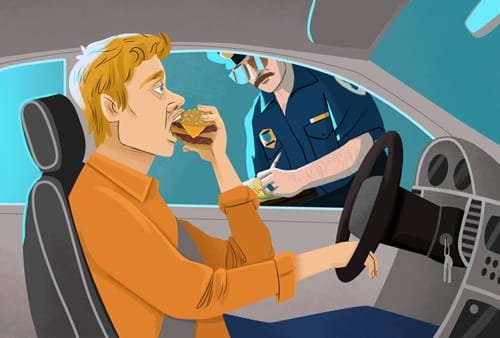
An officer who spots you holding a coffee cup at a red light has no legal basis to stop you for that alone, as long as you’re maintaining your lane, your speed, and general control of the vehicle. The moment eating visibly affects how you’re driving, drifting, sudden braking, delayed reaction to a light change, that same officer now has grounds to pull you over under a general careless or reckless driving statute, or a state’s broader distracted driving law. The food itself was never the violation; the resulting unsafe driving is.
Why California’s Law Reads Broader Than Most People Assume
California’s Vehicle Code Section 23123.5 is frequently cited in this conversation because it’s written broadly enough to cover essentially any activity that diverts a driver’s attention from the road, not just phone use. This means eating and drinking fall within its scope in principle, even though the statute doesn’t call out food specifically by name. In practice, California traffic stops for eating alone remain rare; the statute functions more as a backstop that officers and prosecutors can reach for once erratic driving has already occurred, rather than a tool used to stop someone purely for unwrapping a granola bar.
Open Container Laws Create a Separate, Narrower Trap
Here’s a wrinkle worth knowing about that has nothing to do with distraction at all. Some jurisdictions maintain open container restrictions that technically extend beyond alcohol, and in a handful of narrowly worded local ordinances, an open food or drink container in a vehicle can itself trigger a citation, independent of whether your driving was affected at all. These are far less common than alcohol-specific open container laws, but they exist in certain jurisdictions and catch people off guard precisely because most drivers assume “open container” only ever refers to beer or liquor.
Why This Legal Landscape Keeps Shifting Toward Stricter Rules
Distracted driving law as a whole has followed a fairly consistent evolutionary pattern nationwide. Seat belt laws started as secondary offenses in most states before eventually becoming primary offenses that police could enforce on their own; today, 34 states plus Washington D.C. treat seat belt violations as a primary offense. Distracted driving law appears to be following the same trajectory, moving from broad, general “due care” statutes toward more specific, named activities. Washington’s explicit inclusion of eating is widely viewed as an early signal of where other states may eventually head, rather than a permanent outlier.
What Penalties Actually Look Like When Eating Contributes to a Citation
Since eating rarely stands alone as the charged offense, penalties typically mirror whatever broader distracted or careless driving violation applies in your state. This generally means a fine, and depending on the state, points added to your license. Where eating contributed to an actual collision, the consequences escalate considerably; insurance companies routinely raise premiums following at-fault accidents regardless of what specific distraction caused it, and in serious injury cases, prosecutors can pursue more significant charges tied to reckless operation of a vehicle.
Why the Legal Question Matters Less Than the Practical Risk
Even setting the legal technicalities aside entirely, safety researchers consistently classify eating as a genuine distracted driving risk, since it simultaneously demands your hands, your eyes, and a share of your cognitive attention, precisely the same three categories of distraction that texting and phone use create. The National Highway Traffic Safety Administration treats eating as falling squarely within its broader distracted driving framework, even in the many states where no specific statute names it, because the underlying safety concern is identical regardless of what the traffic code happens to say.
The Practical Approach Most Traffic Attorneys Actually Recommend
Given how this entire area of law works, the safest practical habit isn’t obsessively checking whether your specific state has an eating-specific statute; it’s simply treating any activity that takes your hands or eyes off the road the same way, regardless of legal technicality. Eating at a stoplight while stationary carries essentially no legal or safety risk. Unwrapping food, reaching for napkins, or eating messy items while your vehicle is moving is where both the legal exposure and the actual accident risk genuinely concentrate.
FAQs
Q1. Can I be pulled over just for eating a sandwich while driving, even if I’m not swerving or driving erratically?
Generally no, in states without an eating-specific law, an officer needs to observe some sign of unsafe driving before there’s legal grounds for a stop, so simply holding food isn’t enough on its own.
Q2. Does Washington’s $99 distracted driving ticket for eating apply if I’m stopped at a red light rather than actively driving?
Generally no, these secondary distracted driving provisions are typically tied to operating the vehicle in a way that reflects genuine distraction, so eating while fully stopped tends not to trigger the same citation risk as eating while the vehicle is moving.
Q3. If eating while driving causes an accident, will my insurance treat it differently than a typical at-fault crash?
Not usually differently in category, since insurers generally respond to at-fault accidents with premium increases regardless of the specific distraction involved, though repeated citations for distracted driving can compound that effect over time.
Q4. Are drive-thru restaurants or their customers ever held legally responsible if a driver causes an accident while eating food purchased there?
Generally no, legal responsibility for the accident itself falls on the driver operating the vehicle, since the restaurant has no control over how or where a customer chooses to consume food after purchase.