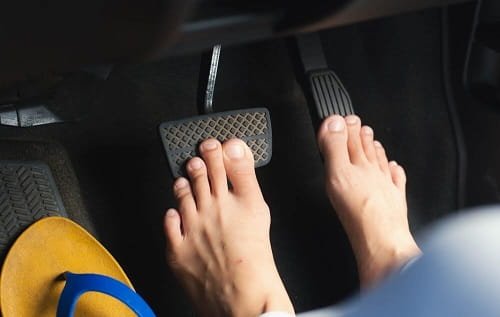
Whether you have kicked off your sandals on a hot day or simply prefer the feel of bare feet on the pedals, the question of barefoot driving is surprisingly common in India. The internet abounds with contradictory claims — some say police can fine you, others say it is perfectly legal. The actual legal position is clear: there is no specific law in India that makes driving a car barefoot illegal. But there are important nuances, especially for two-wheelers, that every driver should understand.
The Clear Legal Position: No Specific Prohibition
The Motor Vehicles Act, 1988 does not mention footwear as a requirement for driving. The Central Motor Vehicles Rules, 1989 — the detailed rules that specify technical and procedural requirements for drivers — similarly do not prescribe any footwear requirement for operating a motor vehicle. In September 2019, Union Transport Minister Nitin Gadkari explicitly clarified via a public tweet that there is no provision under the Motor Vehicles Act (including the newly amended MVA 2019) for imposing a fine or challan for driving in slippers. The tweet specifically stated that the updated Motor Vehicle Act does not penalize individuals for driving in slippers. By extension, since slippers are not prohibited, driving barefoot — which is in many ways less dangerous than wearing loose or ill-fitting slippers — is equally not prohibited by any specific provision.
The Grey Area: Section 184 and Dangerous Driving
While barefoot driving is not specifically prohibited, Section 184 of the MVA (dangerous driving — ‘driving in a manner dangerous to the public’) is a broad catch-all provision. If a traffic officer forms the opinion that driving barefoot is causing impaired vehicle control, and this determination is made in the context of an actual incident or observed unsafe driving, Section 184 could theoretically be invoked. The critical distinction: barefoot driving by itself does not constitute dangerous driving. The barefoot condition + actual unsafe driving + a causal link between the two is needed for any credible Section 184 application. A police officer cannot simply stop you for being barefoot and issue a challan under Section 184 without also observing some form of dangerous driving behaviour.
Safety Reality: When Barefoot Driving Becomes Risky
While legally permissible, barefoot driving raises real-world safety concerns that are relevant to both personal wellbeing and legal liability in the event of an accident. Pedal grip: dry bare feet on smooth metal pedals — especially clutch, brake, and accelerator — can slip, particularly if your feet are sweaty from India’s heat. Emergency braking: maximum brake force requires firm heel contact with the floor and forefoot pressure on the pedal; bare feet may not provide adequate leverage compared to flat-soled shoes. Hot pedals: in Indian summer conditions, metal and plastic pedals inside a parked car can reach very high temperatures, causing sudden pain or distraction when touched with bare feet. Insurance implications: if you are in an accident and it is established that you were driving barefoot and this contributed to reduced braking or control, an insurer may argue contributory negligence in settling your own-damage claim.
Two-Wheelers: State-Level Footwear Rules
While cars have no footwear requirement, some states have specifically addressed footwear for two-wheeler riders (motorcycles and scooters). In some states, riding in flip-flops or open sandals can attract a challan on the basis that such footwear impairs gear shifting and emergency stopping. India TV News reported state-level rules in 2019 where riding two-wheelers in flip-flops attracted a fine of Rs 1,000. The reasoning is sound: a two-wheeler rider’s foot controls (gear shift lever, rear brake) are operated by precise foot positioning, and loose or no footwear creates a specific additional risk at 40-80 km/h on city roads. For two-wheeler riders, wearing proper closed-toe footwear is strongly advisable both for safety and to avoid any state-specific enforcement.
Practical Scenarios
You drove to a beach and removed your shoes: Perfectly legal to drive the car home barefoot. No offence under any current Indian law. You are riding a motorcycle barefoot in a state with specific footwear enforcement: you may attract a challan — check your state’s specific traffic rules. A police officer stops you for some other reason and notices you are barefoot: no additional challan for bare feet alone. The officer’s subjective opinion that it looks unsafe does not make it a punishable offence in the absence of a specific legal provision. You are in an accident while barefoot: the accident investigation may note your barefoot condition, but this alone does not create criminal liability. The standard is whether your driving was negligent, not whether you were wearing shoes.
Conclusion
Driving a car barefoot in India is legal — there is no specific law against it, the MVA and CMVR do not mention footwear, and Minister Gadkari confirmed in 2019 that even driving in slippers attracts no fine. For car drivers, barefoot driving is a personal choice with safety implications but no legal ones — unless the barefoot condition contributes to an accident, in which case general negligence principles apply. For two-wheeler riders, check your state-specific rules and strongly consider wearing proper closed-toe footwear regardless of any specific law — the safety benefit is real and significant.
Frequently Asked Questions (FAQs)
Q1. Can a traffic policeman fine me just for driving barefoot?
No. There is no provision in the Motor Vehicles Act or Central Motor Vehicles Rules that prescribes footwear as a legal requirement for car drivers. A traffic officer cannot issue a valid challan solely for barefoot driving in a car. If a policeman threatens a fine for bare feet, politely ask for the specific Section under which the challan is being issued. In the absence of a specific provision, the challan cannot stand. This was confirmed by Union Minister Gadkari’s 2019 clarification that there is no MVA provision penalising drivers for footwear choices.
Q2. Is it safer to drive barefoot or in flip-flops?
The safety evidence is nuanced. Open flip-flops or loose sandals can slip off the pedal, get caught under the pedal edge, or fall off while driving — all creating sudden control issues. Bare feet, by contrast, provide direct sensory feedback and grip the pedal surface without risk of the footwear becoming an obstacle. Many experienced drivers prefer barefoot to flip-flops for exactly this reason. The ideal footwear is flat-soled, closed-toe shoes that fit snugly, as these combine grip, coverage, and control. However, barefoot is generally safer than loose or high-heeled footwear.
Q3. What if I get into an accident while driving barefoot?
The accident investigation will note all circumstances including your footwear. Being barefoot does not automatically establish negligence or fault. What matters legally is whether your driving was reckless or negligent — barefoot driving is one circumstantial factor among many. In civil compensation claims, the opposing party may argue your barefoot state contributed to reduced control, but this would need to be supported by evidence. Insurance companies may similarly note the condition, but most policies do not specifically exclude accidents involving barefoot drivers — check your policy’s exclusion clauses.
Q4. Are there countries where barefoot driving is specifically illegal?
Yes. Several countries (including South Africa and Spain) specifically prohibit barefoot driving or require footwear while operating motor vehicles. Some US states have informal but non-binding guidance against it. India has not adopted such a specific requirement. Given the very different driving conditions — from rural bullock cart tracks to urban expressways — prescribing a specific footwear standard for India has not been a legislative priority. The focus remains on helmet use (two-wheelers) and seatbelts (cars) as the primary safety mandates.
Q5. What footwear is actually dangerous to drive in?
The most dangerous footwear for driving includes: high heels or wedge shoes (prevent proper pedal feel and leverage); platform shoes (excessive gap between foot and pedal); flip-flops or loose chappals (risk of falling off or getting caught under pedal); very thick-soled boots (reduce pedal sensitivity); and very slippery socks without shoes (no grip on pedal surface). The safest driving footwear is a flat-soled, non-slip, securely fitting closed-toe shoe. If you are wearing high heels or heavy boots, keep a pair of driving shoes in the car and change before driving — this is common practice among professional drivers.