A DOT placard display violation occurs when a vehicle or freight container carrying regulated hazardous materials does not show the hazard warnings required by federal transportation rules. Missing, incorrect, damaged, or obstructed placards can prevent emergency responders from identifying dangers after a collision or spill. Federal law therefore regulates not only which placards are required but also where they are placed and whether they remain readable throughout transportation.
The principal requirements appear in the Hazardous Materials Regulations under 49 CFR Part 172. The correct placard depends on the material’s classification, packaging, amount, and any applicable exception. It is inaccurate to assume that every shipment containing a hazardous substance must display the same warning signs.
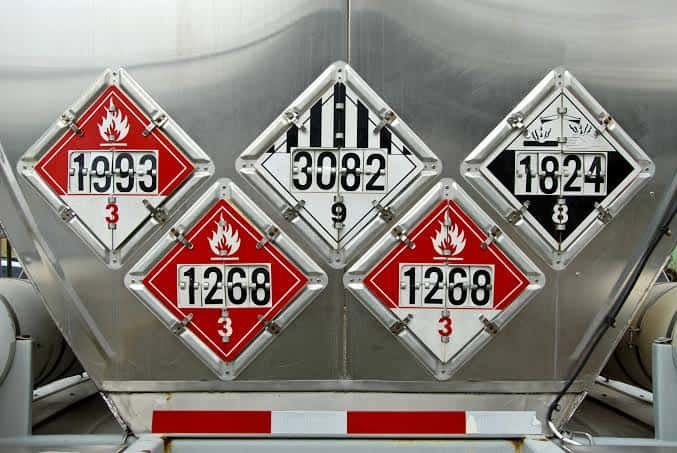
When Are Hazardous Materials Placards Required?
Under 49 CFR 172.504, regulated bulk packages, freight containers, transport vehicles, and railcars generally must display the prescribed placards on each side and each end. Table 1 materials, including certain explosives, poisonous gases, dangerous-when-wet materials, and specified radioactive shipments, are subject to especially strict placarding rules. Subject to applicable exceptions, their placards are required without the ordinary small-quantity exemption available for some other materials.
Table 2 covers additional hazards, including flammable gases, flammable liquids, oxidizers, corrosives, and several other classifications. For qualifying non-bulk shipments moving by highway or rail, a vehicle or freight container carrying less than 454 kilograms (1,001 pounds) in aggregate gross weight of Table 2 materials may be exempt from displaying those placards. This exception is not a blanket exemption for bulk packages or Table 1 substances. Certain other materials have special rules that must be checked separately.
When a shipment contains multiple Table 2 categories, a DANGEROUS placard may sometimes replace separate placards, subject to the regulation’s conditions. For example, when at least 1,000 kilograms (2,205 pounds) of a single Table 2 category is loaded at one facility, that category’s specific placard is generally required even when a DANGEROUS placard is otherwise used.
What Counts as an Improper Placard Display?
49 CFR 172.516 requires placards to be clearly visible from the direction they face, securely attached, properly positioned, and maintained in readable condition. They must not be hidden behind ladders, pipes, doors, tarps, or other equipment. They must also be sufficiently separated from advertising or other markings that could interfere with the hazard message.
A compliant placard normally has the prescribed diamond-shaped design, color, wording, symbol, and size. Under 49 CFR 172.519, the standard diamond measures at least 250 millimeters, approximately 9.84 inches, on each side, subject to specified regulatory provisions. Applying a placard for the wrong chemical class can be as misleading as leaving the required placard off altogether.
Common violations include operating with no required placard, showing an outdated or wrong hazard class, placing placards where other equipment blocks them, allowing them to become illegible, or displaying misleading placards for materials that do not justify them. A package’s hazardous-material label does not automatically substitute for a transport vehicle’s required placard.
Who Is Responsible: Shipper, Carrier, or Driver?
Responsibilities are shared, but they are not identical. Under 49 CFR 172.506, the person offering hazardous material for highway transportation generally must provide the carrier with the required placards unless the carrier’s vehicle is already properly placarded. The motor carrier must not transport the material in a vehicle without the required placards affixed.
A driver should verify that the load and transport documents match the warning displays before departure. Carriers should maintain written acceptance and inspection procedures and train relevant employees on hazardous-material requirements. Whether a particular citation applies to an offeror, carrier, or individual depends on the facts and the rule allegedly violated.
What Are the Penalties for a DOT Placard Violation?
Hazardous-material placarding cases may lead to civil penalties under federal law, as well as operational restrictions when inspectors identify an unsafe shipment. PHMSA’s civil penalty guidelines distinguish an improperly placarded vehicle from one with no placards at all and take the hazard level into account. Illustrative guideline amounts under Appendix A to Subpart D of 49 CFR Part 107 range from several thousand dollars to more than $10,000 for certain placarding failures. These figures are enforcement guidelines, not automatic tickets issued to every driver.
The broader federal maximum under 49 CFR 107.329 is substantially higher for qualifying knowing violations, particularly when serious harm results. A maximum penalty should not be confused with the amount usually assessed for a routine display defect. Penalty decisions depend on the applicable regulation, circumstances, and enforcement record.
How Can Businesses Prevent Placarding Violations?
The most effective control is a shipment-specific check before the vehicle moves. The shipping description and hazard class should be compared with the placard requirements, including the amount and type of packaging. Personnel should inspect all four required viewing directions, confirm that placards match the load, and check attachment and visibility after trailer changes or cargo transfers.
Training should also address mixed loads, bulk packages, and the limits of the 1,001-pound Table 2 exception. A vehicle with spotless paperwork but a missing hazard warning can still be out of compliance. Accurate placarding protects first responders and reduces exposure to substantial federal enforcement consequences.