There’s no federal law banning the scattering of cremated human remains anywhere in the United States. Ashes aren’t classified as a biohazard or environmental contaminant, and every state permits scattering in at least some locations. This is genuinely the most permissive area of death-related law in the country; the legal trend over the past two decades has moved consistently toward loosening restrictions, not tightening them, with several states dropping older requirements that once mandated interment in a licensed cemetery.
Your Own Property Is the Simplest Answer
Scattering on land you own outright carries the least legal complication of any option available. As of 2026, no state prohibits scattering on private property with the owner’s consent, and if that property happens to be yours, you generally don’t need anyone’s permission at all. Basic courtesy still applies here even where the law doesn’t require it; letting nearby neighbors know beforehand avoids confusion, especially if the scattering happens somewhere visible from an adjoining yard.
Someone Else’s Private Land Requires Actual Permission, Not Just Good Faith
This is where families sometimes assume more latitude than the law actually gives them. Scattering on private property that belongs to someone else, a favorite hiking spot on a friend’s ranch, a beloved restaurant’s back garden, a former family home now owned by strangers, requires the current owner’s genuine permission. This applies to seemingly public-feeling private spaces too, including cemeteries, which are frequently privately owned despite feeling like public institutions, along with venues like stadiums and amusement parks that hold real sentimental value for many families but remain firmly private property.
Why the Ocean Has Its Own Federal Rulebook
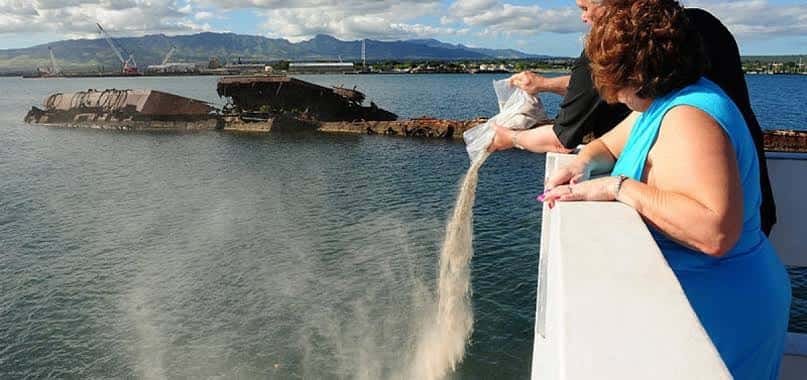
Ocean scattering operates under a completely different legal framework than land-based scattering, governed by the Marine Protection, Research and Sanctuaries Act and enforced through EPA regulations. Under these federal rules, cremated remains must be scattered at least three nautical miles from shore, and whoever performs the scattering, whether that’s a family member or a funeral home, is required to notify the EPA within 30 days afterward. This federal requirement exists nationwide regardless of which state’s coastline you’re standing on, making it one of the few places where a single national rule genuinely overrides the usual state-by-state patchwork.
Why Beaches Themselves Are Often the Trickiest Spot
Here’s the detail that catches families completely off guard. Many people assume that scattering ashes by walking to the water’s edge on a beach and releasing them into the waves satisfies the ocean-scattering rules. It doesn’t, and in states like California, it’s specifically prohibited. California’s Health and Safety Code bans scattering directly on beaches, from piers, or into the ocean from the shoreline; the three-nautical-mile requirement means you genuinely need to be out on a boat or aircraft, well beyond where you can wade in from sand. Attempting to shortcut this by scattering from the beach itself can result in a misdemeanor charge and real fines in states that have written this distinction explicitly into law.
California’s Permit System Shows What the Strictest End of This Looks Like
California requires a disposition permit before ashes can be scattered anywhere, land or sea, and skipping this step can result in a fine up to $500 and up to six months in county jail under the state’s health and safety code. In practice, this permit is inexpensive, typically running $12 to $15, and cremation providers usually handle the paperwork as a routine part of their service rather than leaving families to track it down separately. It’s a genuine legal requirement nonetheless, and it illustrates how even a state broadly permissive about where ashes can go still maintains a formal procedural step families need to complete first.
Why Lakes and Rivers Often Get Treated More Strictly Than the Ocean
This is a distinction worth knowing, since it runs counter to what most people assume. Several states, California included, prohibit scattering into lakes and rivers even while permitting ocean scattering under the federal distance rule. The reasoning tends to center on these being more contained freshwater ecosystems with different environmental protection concerns than the open ocean, meaning a location that feels similarly peaceful and meaningful to a family, a favorite lake rather than the sea, can carry entirely different legal status depending purely on which body of water it happens to be.
Public Parks Follow Their Own Local Rules, City by City
Public parks occupy genuinely inconsistent legal territory depending on which specific park and which city or agency manages it. New York City offers a useful, well-documented example: NYC Parks permits scattering cremated remains on its land, but with specific conditions attached, remains must achieve full, fine dispersal, scattering is prohibited on playgrounds, athletic fields, hard surfaces, or heavily trafficked areas, scattering directly into a body of water isn’t allowed, and no markers, plaques, flowers, or photos can be left behind afterward. Other parks, including many national park units, use a special use permit system requiring advance contact with the specific park’s permitting office, and the guidance from one park unit doesn’t necessarily transfer to another, even within the same broader park system.
Why Checking the Specific Location Beats Assuming Anything
Given how much this varies not just state to state but park to park and even beach to beach within the same state, the most reliable approach is contacting the specific location directly before scattering rather than relying on what worked somewhere else. A national park’s scattering policy, a city park department’s specific guidance, or a state environmental agency’s rules for that particular waterway all take precedence over general assumptions, and confirming directly avoids the situation where a meaningful, carefully planned moment runs into an unexpected citation.
FAQs
Q: Do I need any kind of permit to scatter ashes on my own private backyard?
A: Generally no in most states, since scattering on land you personally own typically requires no permit at all, though a small number of states like California require a general disposition permit regardless of where the scattering takes place.
Q: Is it legal to walk to the edge of a beach and scatter ashes into the waves?
A: Often no, since many states specifically distinguish between shoreline scattering and the federally required three-nautical-mile ocean distance, meaning you may need to be on a boat or aircraft well offshore rather than simply standing on the sand.
Q: Can I scatter ashes in a national park without asking anyone first?
A: No, most national park units require contacting their specific permitting office in advance, since scattering policies vary considerably between different parks even within the same overall park system.
Q: If a friend gives me verbal permission to scatter ashes on their land, is that enough, or do I need something in writing?
A: Verbal permission is often legally sufficient in most states, though getting that permission in writing is generally a wise practice, since it creates clear evidence of consent if any question or dispute arises later.