Starting an NGO in India begins with one important decision: choosing the right legal structure. If you are wondering how to register NGO in India, the first step is understanding which legal form best suits your objectives, team and funding plans.
An NGO is not a separate legal form by itself. Depending on your objectives, team and funding plans, you can generally establish your organisation as a Public Charitable Trust, registered society, or Section 8 Company.
After forming the entity, you may also need income-tax registration/approval, NGO Darpan registration, CSR-1 registration, or FCRA approval, depending on how you plan to raise funds.
This guide explains the complete 2026 process of how to register an NGO in India—from choosing your NGO structure to registration, required documents, costs, tax benefits and funding readiness.
The exact process, documents, fees and timeline depend on the legal structure and the state in which the NGO is being established.
Trust vs Society vs Section 8 Company: Which Should You Choose?
Public Charitable Trust
A trust can be suitable where a relatively small group of trustees wants to undertake long-term charitable activities.
Registration requirements, stamp duty, governing legislation, and procedures can vary by state.
Consider a Trust when:
- You have a relatively small founding group.
- Your activities will initially be concentrated in a particular region.
- You want a trustee-led governance structure.
- Your objectives are primarily charitable or religious.
Registered Society
A society is a membership-based structure commonly used for educational, cultural, social and community organisations.
A Society generally requires at least seven founding members, although state-specific rules must also be checked.
Consider a Society when:
- You have a larger group of founding members.
- You want a democratic or membership-based governance structure.
- Governing-body elections and collective decision-making suit the organisation.
- Your work involves associations, education, community development, or similar activities.
Section 8 Company
A Section 8 Company is incorporated under the Companies Act, 2013 for permitted non-profit objectives.
It follows a corporate governance structure involving directors, members, statutory records, and MCA filings.
Consider a Section 8 Company when:
- You want a formal corporate governance structure.
- You expect institutional donors or corporate partnerships.
- Your organisation intends to operate across multiple locations.
- You are comfortable with comparatively structured annual compliance.
There is no universally “best” structure. The correct choice depends on your objectives, founders, geography, governance preferences, funding strategy, and long-term plans.
| Feature | Section 8 Company | Charitable Trust | Registered Society |
| Governing Law | Companies Act, 2013 | Indian Trusts Act, 1882 / State Trust Act | Societies Registration Act, 1860 |
| Governing Authority | Ministry of Corporate Affairs (MCA) | Deputy Charity Commissioner / Sub-Registrar | Registrar of Societies (State Level) |
| Minimum Members | 2 Members (Private) | 2 Trustees | 7 Members |
| Institutional Credibility | Very High (Strict Central MCA Oversight) | Moderate | Moderate |
| CSR Funding Access | Highly Preferred by Corporate Funders | Moderate Acceptance | Moderate Acceptance |
| Operational Area | Pan-India operations automatically | May require state re-registration | State-bound (requires multi-state filing) |
| Ease of Board Changes | High (Handled via online filings) | Complex (Requires deed amendments) | Complex (Requires state registrar filings) |
Minimum Members Required to Start an NGO
The basic founding requirements differ by structure.
Trust: The minimum number of trustees depends partly on the applicable state law and trust structure. Two or more trustees are commonly used.
Society: Generally requires at least seven members, subject to applicable state law and the nature of registration.
Section 8 Company: A private Section 8 company can generally be incorporated with at least two members and two directors, subject to Companies Act requirements.
Documents Required to Start an NGO in India
Keeping the documents ready before starting registration can substantially reduce delays.
Documents of Founders
Common documents include:
- PAN
- Aadhaar/passport/voter ID/driving license, as applicable
- Address proof
- Recent photographs
- Email address and mobile number
For a Section 8 Company, Digital Signature Certificates may also be required for the proposed subscribers/directors involved in electronic filings.
Registered Office Documents
You may generally need:
- Recent utility bill
- Ownership proof or occupancy document
- Rent/lease agreement, where applicable
- No Objection Certificate from the owner, where required
A residential premises may be used as a registered office subject to the applicable documentation and legal requirements.
Organisation Documents
The principal document depends on your structure.
Trust: Trust Deed
Society: Memorandum of Association and Rules & Regulations/Bye-laws
Section 8 Company: Memorandum and Articles together with the incorporation declarations, proposed objects and other documents required through the MCA incorporation process.
Stuck on drafting your Trust Deed or filing MCA SPICe+ forms?
Don’t let legal jargon slow down your social vision. Let our non-profit legal team prepare your governance docs and fast-track your registration in under 15 days.
How to Start an NGO in India: Step-by-Step Process
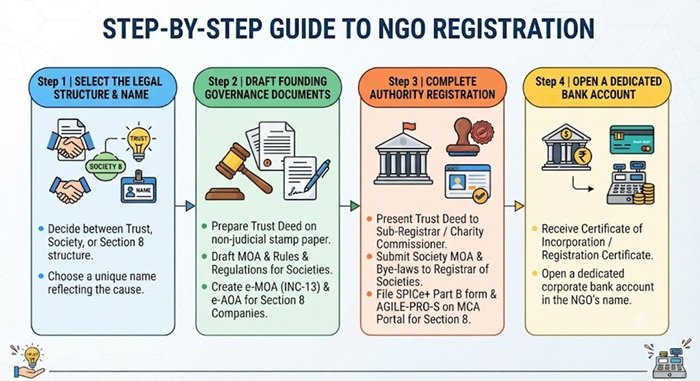
Step 1: Select the Legal Structure & Name
Decide whether a Trust, Society, or Section 8 structure best fits your scope. Choose a unique name that reflects your cause (e.g., “Foundation”, “Association”, “Society”, “Council”, or “Trust”).
Step 2: Draft Founding Governance Documents
Prepare the core legal document required by your selected structure:
- Trust: Draft the Trust Deed on non-judicial stamp paper of appropriate value.
- Society: Prepare the MOA and Rules & Regulations outlining membership rules and governing body elections.
- Section 8 Company: Draft the e-MOA (INC-13) and e-AOA detailing non-profit clauses and dividend restrictions.
Step 3: Complete Authority Registration
- Trust Registration: Present the drafted Trust Deed to the local Sub-Registrar / Deputy Charity Commissioner’s office along with trustees and identity proofs.
- Society Registration: Submit the MOA, Bye-laws, and member forms to the state Registrar of Societies.
- Section 8 Registration: File the integrated SPICe+ Part B e-form on the MCA V3 Portal along with linked forms (AGILE-PRO-S) to secure the company license, PAN, and TAN in a single submission.
Step 4: Open a Dedicated Bank Account
Once you receive your Certificate of Incorporation or Registration Certificate, open a dedicated corporate bank account in the NGO’s official name to manage all financial operations transparently.
How Much Does It Cost to Start an NGO in India?
There is no single fixed NGO registration fee applicable across every structure and state.
The total cost can include:
- Government filing fees
- Stamp duty
- Digital Signature Certificates
- Notarisation
- Drafting of governing documents
- Professional fees
- State registration charges
Trust and Society costs can vary considerably between states because registration procedures and stamp duties are not uniform.
Section 8 Company costs depend on the proposed structure, filings and professional assistance required.
For an accurate estimate, calculate the cost according to the structure + state + number of founders + registrations required rather than relying on a single nationwide figure.
NGO Registration Checklist
Before beginning, confirm that you have:
- Defined the NGO’s objectives
- Selected Trust, Society or Section 8 Company
- Finalised the founders
- Selected the proposed name
- Arranged registered-office documents
- Prepared the governing documents
- Completed entity registration
- Obtained PAN and opened the NGO bank account
- Checked the applicable NPO income-tax registration/approval
- Checked NGO Darpan requirements
- Checked CSR-1 eligibility if seeking corporate CSR projects
- Checked FCRA requirements before accepting foreign contribution
- Established basic accounting and governance controls
Start Your NGO With the Right Structure From Day One
Registering an NGO is only the first step.
The decisions you make at formation can affect your future tax position, governance, government grants, donor confidence, CSR eligibility, and ability to receive foreign contributions.
NGOExperts assists organisations with Trust, Society and Section 8 company formation, NPO tax registration and approval, NGO Darpan, CSR-1 and other NGO compliance requirements.
Not sure whether you should choose a Trust, Society or Section 8 Company?
Speak with an NGO registration specialist before filing so you can choose the structure that fits your team, funding strategy, and long-term objectives.
Get a Free NGO Registration Consultation
Frequently Asked Questions (FAQs)
Q1. Can founders or directors receive a salary from the NGO?
Yes. An NGO can pay reasonable salaries or honorariums to its founders, directors, or trustees, provided the payment is made for actual professional services rendered (such as acting as a managing director, program manager, or doctor) and is approved by the governing board.
Q2. Can I start an NGO using my home address?
Yes. A commercial office is not mandatory. A residential address (owned or rented) can serve as the registered address, provided you submit an electricity bill, lease agreement, and a No Objection Certificate (NOC) signed by the owner.
Q3. How long does it take to complete NGO registration in India?
Section 8 company incorporation takes around 7 to 15 working days via the online MCA portal. Trust and Society registrations generally take 15 to 30 days, depending on local state registrar timelines.
Q4. Is 12A and 80G registration mandatory for an NGO?
While not strictly mandatory to register the entity itself, 12AB and 80G approvals are essential if you want your income exempted from corporate taxes and wish to attract donors who demand tax deduction certificates.