Commercial truck drivers are subject to a combination of federal safety regulations and state traffic laws. A violation may result in a roadside citation, an order taking a driver or vehicle out of service, a federal civil penalty, or an adverse safety record for the carrier. Those consequences are not interchangeable, and there is no single nationwide fine for every “DOT violation.” The result depends on the rule involved, the agency enforcing it, and whether the matter concerns a driver, a motor carrier, or both.
The Federal Motor Carrier Safety Administration (FMCSA) regulates many interstate commercial motor vehicle operations through the Federal Motor Carrier Safety Regulations. State enforcement agencies also inspect trucks and issue citations under their own laws. Understanding the difference helps drivers avoid treating an inspection report as proof that a particular federal fine has already been imposed.

Hours-of-Service and Electronic Logging Violations
Fatigue-related violations are among the best-known trucking compliance issues. Under the standard rules for property-carrying drivers, a driver generally may drive up to 11 hours after 10 consecutive hours off duty and may not drive beyond the 14th consecutive hour after coming on duty. A 30-minute non-driving break is required after eight cumulative hours of driving without a qualifying interruption. Drivers must also observe the applicable 60-hour-in-seven-days or 70-hour-in-eight-days limit, subject to the regulations’ exceptions and restart provisions.
Not all operations follow identical limits. Passenger carriers have different rules, and short-haul, sleeper-berth, adverse-weather, and other exceptions may apply in qualifying circumstances. A trucker who assumes that every break extends the 14-hour window can make an expensive compliance error; ordinary off-duty time generally does not extend that window.
Most drivers who must keep records of duty status are required to use electronic logging devices (ELDs). Exceptions include certain short-haul operations and drivers using paper logs no more than eight days in a 30-day period. Inaccurate logs, unsupported edits, failure to produce records, or operating beyond driving limits can lead to enforcement action. Deliberately falsifying records is more serious than a correctable clerical error.
Vehicle Maintenance and Roadside Inspection Violations
Federal rules require drivers to be satisfied that their trucks are in safe operating condition before driving. Under 49 CFR 396.13, drivers must review required prior inspection reports and confirm that applicable safety defects have been addressed. Section 396.11 governs reports of defects that affect safe operation or could cause a mechanical breakdown. It does not require an empty no-defect report for every property-carrying trip.
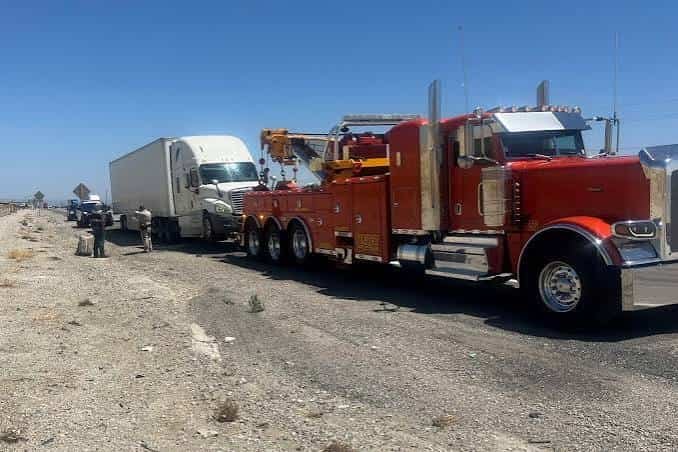
Defective brakes, tires, lighting, steering components, coupling devices, and other safety equipment can produce roadside violations. Serious defects may place a truck out of service until repairs are completed. An out-of-service order is an immediate operating restriction, not simply a warning or a bill that can be paid later.
CDL, Drug and Alcohol, and Hazardous-Material Violations
Commercial drivers may face separate consequences for operating without the proper commercial driver’s license or endorsements, violating an out-of-service order, or breaching federal drug and alcohol testing requirements. A driver who tests positive on a required DOT test or refuses such a test generally cannot resume safety-sensitive duties until completing the prescribed return-to-duty process. The Drug and Alcohol Clearinghouse records specified federal violations; it is not a registry for every state traffic ticket or private employer test.
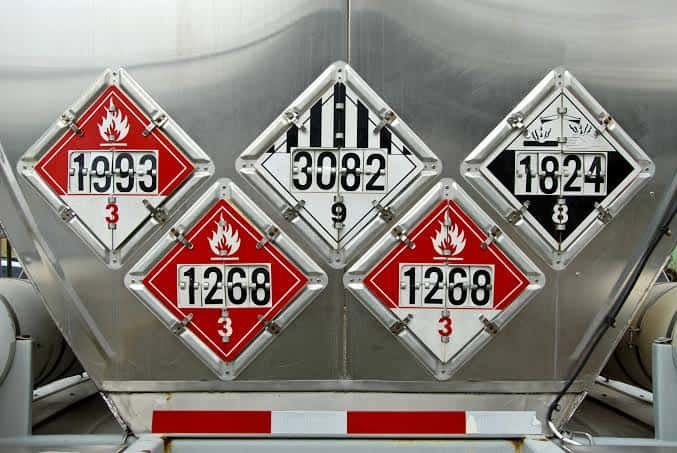
Hazardous-material loads carry additional requirements for shipping papers, training, markings, and vehicle placards. Weight, routing, speed, distracted-driving, and electronic-device rules may also be enforced under state law. Some violations affect a driver’s record, while others primarily affect the motor carrier’s compliance history.
How Much Is a DOT Trucking Violation Fine?
There is no reliable flat-rate answer. FMCSA’s penalty schedule in Appendix B to 49 CFR Part 386 identifies different federal categories and ceilings, including recordkeeping failures, knowing falsification, commercial driver’s license violations, and hazardous-material breaches. Federal amounts are adjusted by rule and can differ sharply from state-issued traffic fines. Some enforcement actions assess the carrier rather than the individual behind the wheel.
A roadside inspector may also declare a driver or vehicle out of service under applicable criteria. The resulting lost operating time, repair costs, missed deliveries, and insurance consequences can exceed the amount of a particular traffic ticket. On the other hand, a citation does not automatically suspend a CDL or prove that an employer is legally responsible for every driver action.
What Should a Driver Do After a Violation?
A driver should preserve the inspection report and any citation, identify the exact regulation alleged, and comply immediately with any out-of-service restriction. The next step depends on who issued the document. A state citation generally follows the issuing jurisdiction’s court or administrative process; a federal notice follows the procedures stated in the notice. FMCSA’s DataQs system can be relevant to challenging inaccurate safety data, but it is not a substitute for contesting a traffic ticket in court.
Preventive practices include accurate duty-status records, proper documentation, defect reporting, valid credentials, and clear communication with dispatch. Compliance is ultimately about operating safely, not merely finding a cheaper way to pay a fine.