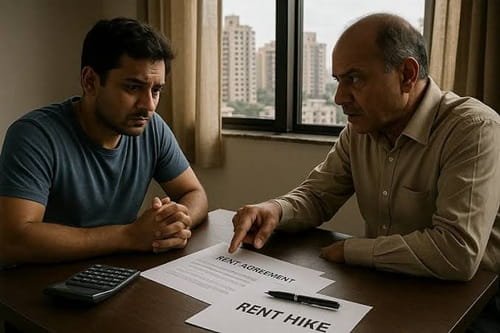
Rent revision is one of the most common sources of tension between landlords and tenants in India. Landlords believe they are entitled to increase rent annually to keep pace with inflation and market rates. Tenants believe they cannot be forced to accept sudden large increases. Both sides are partially right — the legal position depends on what state you are in, whether Rent Control legislation applies to your property, and critically, what your rental agreement says.
The Dual Framework: Rent Control vs Contract Law
India’s rental law operates through two overlapping frameworks: State Rent Control Acts: Most states (Delhi, Maharashtra, Tamil Nadu, West Bengal, Karnataka, etc.) have their own Rent Control Acts that regulate rent levels and revision for covered properties. These typically apply to older residential and commercial properties below certain rent levels. They impose strict caps on rent increases. Contract/Agreement Law: For newer properties, premium rentals, commercial properties, and properties not covered by Rent Control, the rental agreement is the primary governing document. Rent increases are whatever the agreement says — subject to mutual consent and notice requirements. The Model Tenancy Act (MTA) 2021: The Central Government proposed a Model Tenancy Act that several states have been asked to adopt. Under the MTA framework, rent can be revised once every 12 months, with 90 days’ written notice to the tenant. Some states have adopted this; others have not yet updated their laws.
Under Rent Control Acts: Strict Caps
Where State Rent Control Acts apply, landlords cannot freely increase rent according to market conditions. The key restrictions: Delhi Rent Control Act: rent can only be increased once every three years, and the increase is capped at approximately 10% over the three-year period. This is a hard cap — courts have upheld it even when landlords argued it was too low to keep pace with market rates. Maharashtra: the Rent Control Act as amended provides for periodic rent revision at government-set guidelines; landlords cannot unilaterally impose higher increases. Tamil Nadu: annual increases are capped at fair market rates as determined by the Rent Control Authority. West Bengal: similar provisions for periodic revision with caps.
Under Rent Control Acts, a landlord who increases rent beyond the permitted cap is committing an unlawful act. The tenant can: refuse to pay the excess; approach the Rent Control Authority for determination of fair rent; and have the excess recovery declared illegal.
Under Rental Agreement: What the Contract Says Governs
For properties not covered by Rent Control Acts (typically newer properties, premium rentals, properties above a threshold value, commercial properties rented to large companies), the rental agreement is king. A standard rental agreement typically contains a clause like: ‘The monthly rent shall be subject to an annual increase of 7-10% after the completion of 12 months from the commencement of this agreement. The revised rent shall be communicated in writing with a minimum notice period of 60-90 days.’ If your agreement says rent increases annually by a fixed percentage with proper notice, that is the legally binding term. Neither party can unilaterally change it without the other’s consent. If the agreement is silent on rent revision: the landlord cannot unilaterally increase rent during the tenancy term. At lease renewal (when the old lease expires and a new one is negotiated), the landlord can offer a higher rent — and the tenant is free to accept or negotiate.
The Model Tenancy Act 2021 Framework
The Model Tenancy Act (MTA), 2021 — proposed by the Central Government and sent to states for adoption — establishes a clear framework: Rent revision: only once every 12 months (not more frequently). Notice requirement: landlord must give minimum 90 days’ written notice before any rent increase. Cap: states may additionally define a maximum percentage increase per year, typically 3-5%. Security deposit: capped at 2 months’ rent for residential properties and 6 months for commercial. As of 2025, several states are reviewing their rent laws to align with the MTA framework. Under the MTA framework, annual increases with 90 days’ notice are legally protected.
Practical Norms Across India
In areas not specifically covered by strict Rent Control Caps, the following practical norms prevail and courts generally consider reasonable: Residential properties: 5-8% per year (annual revision with 30-60 days’ notice) is considered a reasonable and standard market practice. Commercial properties: 5-8% for long-term leases; 10-15% for shorter commercial leases is more common. Many commercial leases have built-in escalation clauses. The notice period matters legally: Under Section 106 of the Transfer of Property Act, 1882, landlords must give prior written notice of any rent revision. A unilateral rent increase without written notice is not legally binding until the tenant has been properly notified.
Can a Landlord Evict a Tenant for Refusing a Rent Increase?
Under most State Rent Control Acts, a landlord cannot evict a tenant simply because the tenant refuses to accept a rent increase beyond the legally permitted cap. Eviction requires specific statutory grounds (non-payment of agreed rent, damage to property, landlord’s personal requirement, etc.). For properties governed only by contract law: if the tenant refuses to accept the rent increase stipulated in the agreement at renewal, the landlord can refuse to renew the lease. This does not entitle the landlord to forcibly evict — they must obtain an eviction order through proper legal channels.
Final Thought
Raising rent every year is legal in India if: the state’s Rent Control Act permits annual revision (not all do — Delhi caps revision at once every 3 years with a 10% ceiling); or the rental agreement specifically provides for annual revision with proper notice; or the property is not covered by Rent Control and the landlord gives sufficient written notice. The key protections for tenants: no unilateral mid-tenancy rent increase without agreement provision; mandatory written notice (90 days under MTA framework); Rent Control Act caps where applicable; and the right to approach the Rent Control Authority if unlawful rent is demanded.
Frequently Asked Questions (FAQs)
Q1. My landlord wants to increase rent by 50% — is this legal?
Almost certainly not, and almost certainly unenforceable. If your property is covered by a State Rent Control Act, any increase beyond the Act’s permitted percentage cap is illegal — the tenant can refuse to pay the excess and approach the Rent Control Authority. If the property is governed only by your rental agreement, the increase must match what the agreement’s revision clause says — typically 5-10% annually. A 50% demand has no legal basis unless mutually negotiated in a fresh agreement at lease renewal. Do not vacate simply because a landlord makes an unreasonable demand. Seek legal advice, and approach the Rent Control Authority or Civil Court if the landlord threatens eviction.
Q2. What is the legal notice period required before a rent increase?
Under the Model Tenancy Act 2021 framework: minimum 90 days’ written notice. Under the Transfer of Property Act, Section 106: prior written notice is required before any change to tenancy terms including rent. Under individual State Rent Control Acts: periods vary (30-60 days is common). Your rental agreement may specify its own notice period — if so, that governs. A verbal announcement of a rent increase is not legally binding. Any rent increase notice must be in writing (email, WhatsApp message, or letter), clearly stating the new amount and the date from which it applies.
Q3. Can a landlord increase rent during the rental agreement period?
Generally no. The rental agreement creates a binding contract for its term. Mid-term unilateral rent increases (before the agreement expires) are not permitted unless the agreement itself specifically provides for them with a clear formula. A landlord who demands higher rent mid-term (e.g., on a 2-year lease after 6 months) is in breach of the agreement. The tenant can continue paying the original agreed rent and refuse the increase. At lease renewal (when the original term expires), the landlord can negotiate new terms including higher rent.
Q4. I am paying rent without any written agreement — can my landlord suddenly increase rent?
Without a written agreement, rent terms are governed by oral evidence and prevailing custom. A landlord cannot increase rent without proper notice even without a written agreement — the Transfer of Property Act requires notice before changes to tenancy terms. However, the absence of a written agreement makes disputes much harder to resolve in your favour. Immediately formalise your tenancy with a written, registered agreement specifying: current rent, revision formula, notice period, security deposit, and term. This protects both parties.
Q5. My landlord is threatening to cut off water and electricity if I don’t accept the rent hike — is this legal?
No. Cutting off essential services (water, electricity, gas) to coerce a tenant into accepting a rent increase is illegal. Multiple High Courts have held that landlords cannot disconnect or threaten to disconnect essential services for a tenant who is paying agreed rent — this constitutes wrongful restraint and harassment. BNS Section 351 (criminal intimidation) may also apply. File a police complaint immediately if your landlord threatens or executes such disconnection. The landlord can be ordered to restore services and may face criminal action. Do not vacate under such coercion — continue paying the agreed rent and seek immediate legal relief from the Rent Control Authority or a Civil Court.