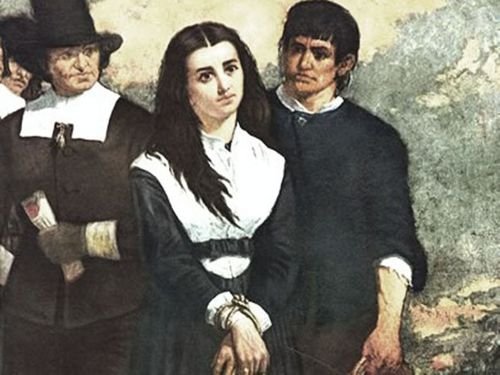
Sarah Good was one of the first women accused of witchcraft during the Salem panic of 1692. Neighbors claimed she used supernatural powers to harm local girls, and colonial magistrates ordered her arrest on February 29. Good denied practicing witchcraft, but she was tried, convicted and hanged on July 19, 1692. Her case is now understood as part of a grave miscarriage of justice, not evidence that the supernatural accusations were true.
Who was Sarah Good?
Good lived in Salem Village in the Massachusetts Bay Colony. Financial troubles and difficult family circumstances had left her and her household in poverty. Historical studies describe the family as moving between lodgings and depending on neighbors’ assistance. Good was sometimes regarded by others as argumentative or ungrateful, making her socially vulnerable in a community that placed strong emphasis on conformity and religious reputation. Poverty and strained relationships helped make her an early target, but neither was evidence of witchcraft.
How did the accusations begin?
In early 1692, several girls in Salem Village experienced alarming episodes that adults interpreted as evidence of supernatural attack. Their accusations initially focused on Tituba, Sarah Osborn and Sarah Good. The first warrants were issued on February 29, 1692. According to surviving court papers, Good was suspected of inflicting harm on children including Betty Parris, Abigail Williams, Ann Putnam and Elizabeth Hubbard. Colonial officials treated claims about invisible spirits and sudden afflictions as serious criminal evidence, reflecting the beliefs and legal practices of the period.
What happened when Good was questioned?
Good appeared before magistrates on March 1, 1692. She repeatedly denied being a witch or harming the accusers. Surviving examination records preserve her denials and the girls’ accusations. Some witnesses described her muttering after neighbors refused requests for help, which they interpreted as threatening. Other accounts involved fits or visions supposedly caused by her spirit. Modern historians distinguish these testimonies from objective proof. The ability to accuse a marginalized neighbor without physical evidence made the proceedings particularly dangerous.
What is spectral evidence?
Spectral evidence consisted of testimony that an alleged witch’s specter or spirit had appeared and caused harm, even though the accused person was not physically present. During the Salem proceedings, the court treated this type of testimony as significant. That created an almost impossible defense: a person could deny the alleged act, but could not disprove what another witness claimed to have seen in a vision. The Massachusetts Archives notes that the Court of Oyer and Terminer allowed spectral evidence and that its use contributed to convictions.
Was Sarah Good’s child also accused?
Yes. Sarah Good’s young daughter Dorothy, also referred to as Dorcas in some records, was accused of witchcraft and imprisoned. Historians differ on the exact age reported in later accounts, but the essential fact is that she was a small child. A separate infant daughter, Mercy, died while Good was imprisoned. These events show that the panic damaged entire families, including children who were unable to understand or challenge the accusations against them. The Salem record should not be reduced to a story of isolated courtroom proceedings.
How did her trial end?
A court convicted Good of witchcraft and sentenced her to death. She was executed by hanging on July 19, 1692, alongside Rebecca Nurse, Susannah Martin, Elizabeth How and Sarah Wildes. Surviving execution records identify those five women. Good’s denials continued throughout the proceedings. She was not executed because any supernatural activity was established by modern evidentiary standards; she was executed under a colonial system that wrongly accepted unreliable accusations and deeply prejudicial testimony.
Was Salem’s legal system later reconsidered?
The Salem prosecutions began to unravel within months. Governor William Phips dissolved the special Court of Oyer and Terminer in October 1692, and the subsequent court rejected spectral evidence. Eventually the remaining imprisoned people were released. Massachusetts later provided legal redress and compensation to some victims’ families. The Peabody Essex Museum and state archival collections preserve the chronology and documents that make these developments traceable today.
What do the surviving court documents show?
Warrants, examinations, indictments and execution papers survive in archival collections and allow historians to reconstruct the prosecution. These documents identify accusers, record the magistrates’ questions and establish the chronology more securely than later retellings. They also show why the proceedings were fundamentally unreliable: claims about unseen spirits could be accepted even when the accused denied any wrongdoing and ordinary physical evidence was missing. Modern museums and archives draw on these records to correct familiar myths about Salem, including the false idea that convicted people were burned rather than hanged.
Why is Sarah Good’s case important in legal history?
The case illustrates the consequences of assuming guilt, relying on unverifiable evidence, permitting social prejudice to affect prosecution and denying meaningful safeguards to accused people. Today the Salem trials are studied in relation to due process, fair trials and the need to test accusations against reliable evidence. Good was a real woman with a family and a documented legal history, not merely a fictional symbol of witchcraft. Her wrongful execution remains a warning about what can happen when fear outruns the rule of law.